July 24, 2026
—
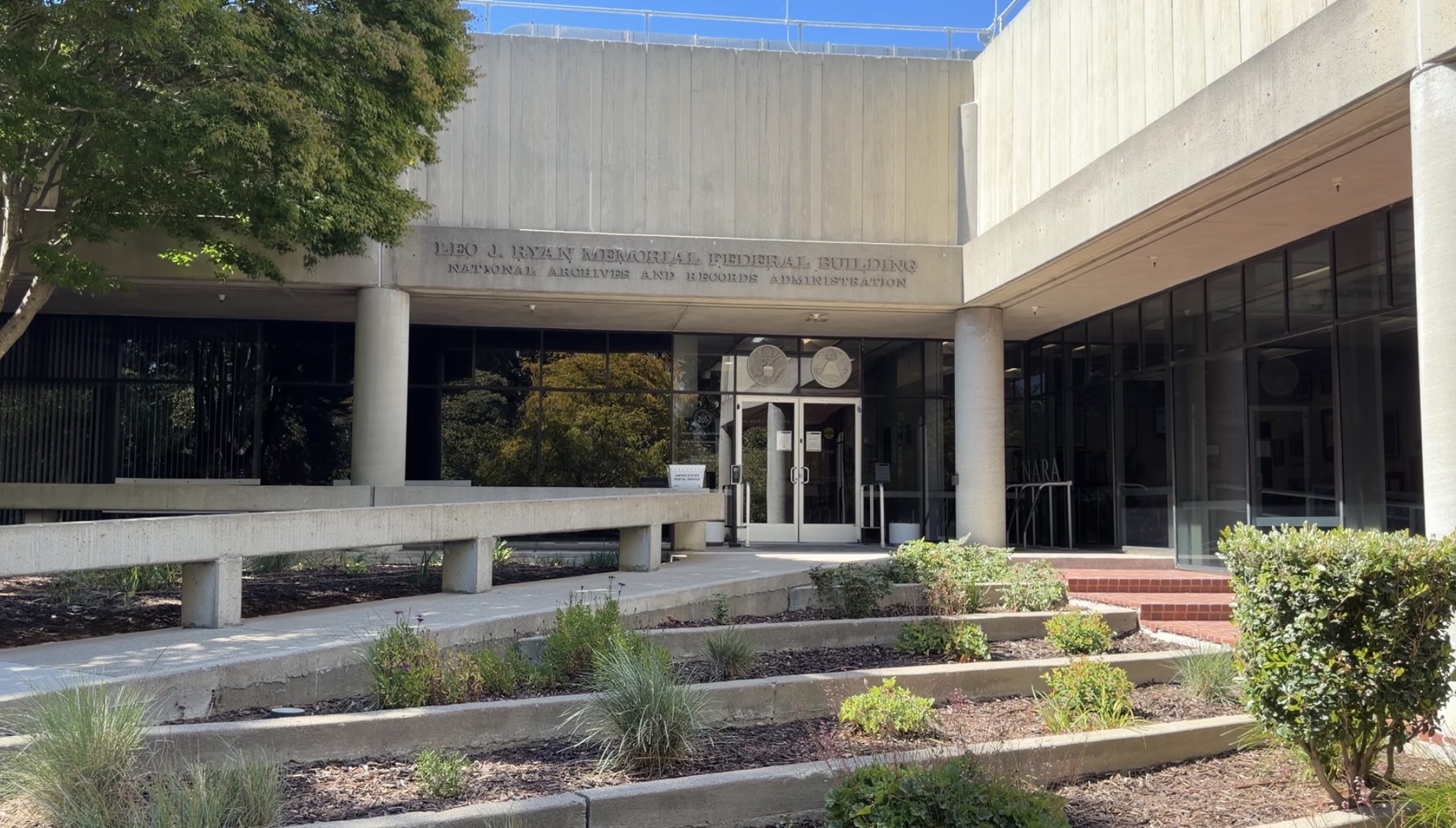
Densho opposes the National Archives and Records Administration’s (NARA’s) announced plans to close its facilities in Chicago, IL, and San Bruno, CA. The closures would threaten regional access to irreplaceable primary sources, disperse staff expertise and institutional knowledge, and separate communities from records documenting their own histories.
Since NARA announced the plans on June 23, community members and organizations have organized rapidly—not only to oppose the closures but also to identify records for digitization before they are relocated or made inaccessible for extended periods of time. Densho is contributing to these efforts by documenting the consequences for proposed closures, advocating for continued regional access, leading digitization work, and fighting for continued access to critical records documenting Japanese American, Asian American, and immigrant histories.
As the Organization of American Historians (OAH) notes, the Chicago and San Bruno facilities were built in the early 1970s “on the promise that regionally created, historically valuable records would remain accessible to the communities that created them.” These records—including immigration, court, and genealogical records, as well as those of the Army Corps of Engineers, the Bureau of Indian Affairs, and the Immigration and Naturalization Service—exist almost entirely as paper originals. Keeping federal records in the regions makes them most useful to the communities they document, and some materials cannot be digitized safely because of their condition.
Of particular concern to Densho are records and materials related to the immigration, exclusion, naturalization, and wartime incarceration of Japanese Americans.
The San Bruno facility holds individual case files maintained by the Immigration and Naturalization Service for Issei, the first generation of Japanese immigrants. These files document the lives of people who were legally barred from naturalization and experienced the direct consequences of wartime incarceration. The Chicago facility holds naturalization records of the Issei, created after the McCarran-Walter Act of 1952 finally made naturalization available to Japanese immigrants. Together, these records illuminate a community’s relationship with the U.S. government across more than a century. It traces a complex history from exclusion, through wartime incarceration, to the right to naturalize.
Because of practical and legal barriers to digitization, some of these records could become inaccessible for extended periods, while others may become substantially more difficult for families and researchers to use. Some of these records document aspects of the wartime incarceration that have yet to be studied and written about publicly. NARA has indicated that relocation could begin within the next few months. The proposed closures therefore pose an immediate threat not only to historical research but also to communities’ ability to understand and recover their own histories.
As an organization dedicated to historical preservation, public accessibility, and community stewardship, Densho urges NARA to:
- Reconsider alternatives to closure that would preserve regional access to the collections in Chicago and San Bruno;
- Ensure continued on-site, in-person research access to the collections within the regions they serve;
- Disclose a complete plan about the closure and relocation process (including locations, timelines, staffing decisions, public access options, and available services);
- Pause any relocation of archival holdings until that information is provided, and affected communities have had the opportunity to review and respond to that plan;
- Work with Congress to evaluate sustainable alternatives that provide adequate resources for preservation, staffing, and regional access.
We outline these demands in greater detail in a letter to Acting Archivist of the United States Edward Forst, which you can read here.
Densho’s Preservation Efforts
Since NARA’s announcement, Densho has been working both publicly and behind the scenes to safeguard historically significant material that could become more difficult to access. We are coordinating with community members, other organizations, and archivists to identify which records are most urgent to digitize and to prioritize collections with the greatest historical and community value. Densho Archives Director Caitlin Oiye Coon recently visited the San Bruno facility to assess the collections firsthand and begin digitizing selected materials.
A coordinated, systematic approach is essential. Effective digitization requires that records be accurately identified, described, organized, and connected to the information that makes them discoverable and understandable. Without coordination, separate efforts may duplicate the same materials while leaving other important records untouched. However, even a careful and robust community digitization effort cannot reproduce the scale of NARA’s holdings or replace the expertise of archivists who have worked with these collections for decades.
In a forthcoming post, Caitlin will describe some of the incarceration-related materials held at San Bruno, explain how Densho selects, documents, and digitizes archival records, and make clear why digitization cannot substitute for staffed, regionally accessible archives.
What You Can Do
Densho stands with the organizations and community members mobilizing in both affected regions. Here are some ways that you can help:
- Follow Save Our National Archives (SONA), a coalition of genealogists, researchers, and community members that has led the fight to protect these facilities since 1998, when regional archives faced a similar threat. SONA is now leading a letter-writing campaign to oppose the current closures, asking concerned community members and organizations to write to Edward Forst, Acting Archivist of the United States.
- Support the Chicago campaign. Visit Chicago Area Archivists (CAA)’s action page to contact government officials, write to NARA leadership, and sign the Chicago petition.
- Read and share Densho’s letter which explains how both closures would affect access to records documenting Japanese American immigration, exclusion, naturalization, and wartime incarceration.
- Tell us about materials you have already digitized. If you have photographed or scanned records at the San Bruno or Chicago facilities, contact Densho and share information about them. Please include the facility, collection or record group, box and folder numbers, dates, subjects, and any other available metadata. Please do not send files containing personally identifiable information or other restricted materials unless Densho has first confirmed an appropriate and secure process for receiving them.
- We urge our supporters to write their own letters to their Congressional representatives, including representatives that serve on NARA’s Appropriations and Oversight Committees. In addition to Densho’s letter, we suggest referencing the OAH’s letter for possible talking points.
Together, We Can Make a Difference
History shows that collective public pressure works. In 2020, NARA announced plans to close and sell its Seattle facility, which holds records central to the histories of Pacific Northwest and Alaskan tribes, immigrant communities, and the Chinese Exclusion Act era. A sustained campaign led by tribal nations, journalists, archivists, and elected officials—including the threat of a lawsuit from Washington’s Attorney General—led the federal government to reverse course in 2021 and withdraw approval of the closure and sale.
Additional attempts in the past have been made to close National Archives facilities, which were similarly challenged and successfully thwarted. In fact, as stated on its website, SONA originally formed to protest the proposed closure of thirteen regional national archives in 1998. Additionally, its later advocacy efforts from 1998 to 2009 led to the preservation of the Alien Case Files as historical records to be kept permanently at the National Archives.
These precedents make clear that these closures are not inevitable. When communities, organizations, and advocates organize and speak up together, NARA has reversed course—it happened in the past, and it can again. Together, we can make a stand to protect public history for all.
—
This is an evolving situation, and Densho will continue to closely monitor developments at both the Chicago and San Bruno facilities. We will share updates as they become available, and we expect new opportunities for action to arise as this fight continues. We thank our community for standing with us in this collective effort to protect these irreplaceable records and the histories they hold.
Learn More
- Adhiti Bandlamudi, “Exclusive: The Bay Area’s National Archives Office Is Closing. Researchers Are Worried.” KQED, June 26, 2026,https://www.kqed.org/news/12088904/exclusive-the-bay-areas-national-archives-office-is-closing-researchers-are-worried.
- Save Our National Archives (SONA), “National Archives in San Bruno Threatened with Immediate Closure.” SONA Press Release, June 28, 2026,https://docs.google.com/document/d/1AbmM0t5MbeCnB8jex34JqEOkea-HtFjB2SbwX7spcCU/edit?tab=t.0.
- Organization of American Historians, “OAH Sends Letter of Concern to Acting AOTUS about Announced Regional National Archives Closures.” July 20, 2026,https://www.oah.org/2026/07/20/oah-sends-letter-of-concern-to-acting-aotus-about-announced-regional-nara-closures/.
- Holly Rusch. “San Bruno National Archives Closure Plans Causing Concern.” San Mateo Daily Journal, July 1, 2026,https://www.smdailyjournal.com/news/local/san-bruno-national-archives-closure-plans-causing-concern/article_94b22b20-45f4-4d96-93c5-e93e3c4bd137.html.
[Header image: San Bruno National Archives. Photo by Miya Schilz, July 21, 2026]