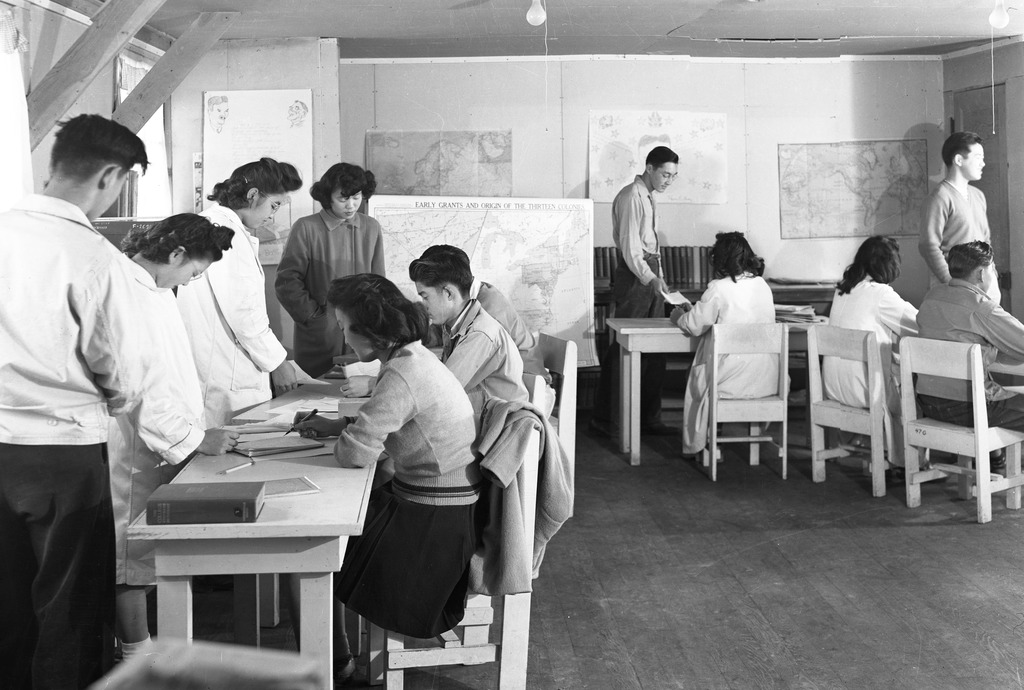
#1: First-hand accounts and historical interpretation are essential to understanding Japanese American wartime incarceration history.
There are an enormous number of primary sources and testimonies, of former incarcerees and descendants, that address aspects of the wartime incarceration, many of which are available online.
Oral history is an important source of incarceree voices. Conducting oral histories was the impetus for Densho’s founding, and the Densho Digital Repository (DDR) includes over a thousand oral histories. For a selection of highlights from these interviews, see also Densho’s YouTube page. In addition to Densho’s own oral histories, the DDR also includes oral histories from other sources. Among the most significant are those from the CSU Fullerton Center for Oral and Public History, Japanese American Oral History Project Collection, which includes oral histories from the 1970s to the 2010s, and thus includes more adult recollections of the incarceration.
Contemporaneous records, such as diaries, journals, and letters written by incarcerees as they were experiencing exclusion and incarceration, provide largely unmediated viewpoints from a variety of perspectives. While many are collected in various archives, only a handful are available online. A particularly valuable collection that is online is the Japanese American Evacuation and Resettlement Records at the Bancroft Library, University of California, Berkeley. This collection consists mostly of records from the War Relocation Authority, the federal agency that ran the concentration camps, as well as the Japanese American Evacuation and Resettlement Study, a Berkeley-based research project that includes the contributions of many Japanese American fieldworkers. Densho’s DDR also includes some contemporaneous records. Search for “diaries,” “journals,” or “letters.”
Over the years, there have also been dozens of memoirs written by incarcerees. See the Densho Encyclopedia and the Densho Resource Guide to Media on the Japanese American Removal and Incarceration for lists of such memoirs.
See also the hearings of the Commission on Wartime Relocation and Internment of Civilians, described more fully below in Guideline #9.
#2: Long-standing racism and xenophobia shaped the incarceration, and euphemistic language concealed its injustice.
What historians have called the “anti-Japanese movement” began soon after large-scale migration from Japan to the Kingdom of Hawai‘i and the United States in the late 1800s. Many historians argue that the decision to exclude/incarcerate Japanese Americans during World War II represented a continuation of this movement. Among the key works on the anti-Japanese movement are Roger Daniels’ The Politics of Prejudice: The Anti-Japanese Movement in California and the Struggle for Japanese Exclusion (University of California Press, 1962, 1977), Morton Grodzins’s Americans Betrayed (University of Chicago Press, 1949), Jacobus TenBroek et al. Prejudice, War, and the Constitution (University of California Press, 1956), Yuji Ichioka’s The Issei: The World of the First Generation Japanese Immigrants, 1885-1924 (The Free Press, 1988), and Gary Y. Okihiro’s Cane Fires: The Anti-Japanese Movement in Hawaii, 1865-1945 (Temple University Press, 1991). Erika Lee’s The Making of Asian America (Simon & Schuster, 2015) provides a broad introduction to anti-Japanese and anti-Asian racism. Lee and Christina Soontornvat adapted this into a young reader’s edition for middle school students, Made in Asian America: A History for Young People (HarperCollins Publishers) in 2026.
The recognition of the euphemistic nature of official language regarding the exclusion and incarceration began during the movement for redress and reparations in the 1980s and picked up again in the 2000s. On euphemistic language (beyond Densho’s terminology guidelines), see Raymond Y. Okamura’s “The American Concentration Camps: A Cover-Up through Euphemistic Terminology” (Journal of Ethnic Studies 10.3 (Fall 1982): 95-108), The JACL’s “The Power of Words,” and Roger Daniels’ “Words Do Matter: A Note on Inappropriate Terminology and the Incarceration of the Japanese Americans” inLouis Fiset and Gail Nomura, eds. Nikkei in the Pacific Northwest: Japanese Americans and Japanese Canadians in the Twentieth Century (University of Washington Press, 2005, pp. 183-207), reprinted in Discover Nikkei, 2008. The JACL’s “The Power of Words,” is an accessible resource that could be used with secondary students or older.
#3: Economic, political, and legal systems facilitated mass incarceration.
#4: The incarceration was unjust, unnecessary, and unconstitutional.
There is an enormous body of literature on the factors that led to the decision to forcibly remove Japanese Americans from the West Coast. Morton Grodzins’ Americans Betrayed: Politics and the Japanese Evacuation (University of Chicago Press, 1949) was the first work to seriously examine this topic and focused on the role of West Coast politicians and pressure groups, such as the California Joint Immigration Committee and agricultural groups, in convincing federal officials to enact a mass exclusion policy. Grodzins did the research for Americans Betrayed while working for the University of California-based Japanese American Evacuation and Resettlement Study (JERS). Over the last decade, the Bancroft Library at UC Berkeley has digitized much of this collection and made it available online as part of the Japanese American Evacuation and Resettlement Records collection. Grodzins’ records include material gathered from Western politicians and pressure groups, correspondence files, newsclippings of both mainstream and Japanese American newspapers, and much more. (Search for “Grodzins” in the finding aid.)
A generation later, when key government records became available, a new set of works appeared that illuminated the decision making process within the Roosevelt administration. The key work was Roger Daniels’ Concentration Camps, U.S.A.: Japanese Americans and World War II (Holt, Rinehart and Winston, 1971). Also in the 1970s, Michi Nishiura Weglyn published Years of Infamy: The Untold Story of America’s Concentration Camps (Morrow, 1976; University of Washington Press, 1996). Another decade later, in the context of the Redress Movement and reconsideration of the Japanese American wartime cases, Peter Irons’ Justice at War: The Story of the Japanese American Internment Cases (Oxford University Press, 1983; University of California Press, 1993) drew on newly discovered archival findings to show that the government hid or altered key evidence about Japanese Americans from the Supreme Court. Relatively little on this topic has appeared since, the key exception being Greg Robinson’s By Order of the President: FDR and the Internment of Japanese Americans (Harvard University Press, 2001), which further illustrates the role of the president himself in the decision. Another take on the causes of the incarceration comes from Brian Hayashi’s Democratizing the Enemy: The Japanese American Internment (Princeton University Press, 2004).
Most recently, the popular podcast Rachel Maddow Presents: Burn Order, focuses on this topic, drawing on the work of Irons and others in an accessible way.
#5: The incarceration transcended borders to include Japanese Canadians and Japanese Latin Americans during World War II.
Along with Japanese Americans, Japanese Canadians and Japanese Latin Americans were also incarcerated during World War II. In the case of Japanese Latin Americans, the United States directed Latin American states (Peru, Panama) to deport their Nikkei communities to the U.S. for detention.
Like the United States, Canada forcibly removed all 22,000 Japanese Canadians residing in British Columbia — the overwhelming majority of all Japanese Canadians. Beginning in February 1942, the Canadian government implemented measures under PCs 1486 and 1665 to forcibly remove Japanese Canadians to camps located east of the Canadian Rockies. Ultimately, the British Columbia Security Commission sent 12,000 Japanese Canadians to one of the six camps and another 10,000 relocated to eastern Canada. Unlike the United States, the Canadian government forcibly auctioned off the property of Japanese Canadians — an act to permanently expel Japanese Canadians from British Columbia. And, like Japanese Americans, Japanese Canadians were forced to qualify their loyalty to Canada, leading some to self-deport to Japan. It would not be until April 1949 that Japanese Canadians could return to Western British Columbia, four years after the end of hostilities with Japan.
For more about Japanese Canadians, see Mazumi Izumi’s article in the Densho Encyclopedia, which also lists many additional resources. See also the article by Greg Robinson (updated by Andrew McIntosh) in The Canadian Encyclopedia. Ken Adachi’s The Enemy that Never Was: a History of the Japanese Canadians (McClelland & Stewart, 1976)provides a comprehensive overview of this history. A more recent (and accessible) take is Jordan Stanger-Ross’Landscapes Of Injustice: A New Perspective On The Internment And Dispossession Of Japanese Canadians (McGill Queens Press, 2021) and companion website. Both Mona Oikawa’s Cartographies of Violence: Japanese Canadian Women, Memory and the Subjects of Internment (University of Toronto Press, 2012) and Kirsten Emiko McCallister’s Terrain of Memory: A Japanese Canadian Memorial Project (University of British Columbia Press, 2010) take on the memorialization of Japanese Canadian experience.
For Japanese Latin Americans, C. Harvey Gardiner’s Pawns in a Triangle of Hate: The Peruvian Japanese and the United States (University of Washington Press, 1981) remains the only monograph focused solely on this topic, while Seiichi Higashide’s Adios to Tears: The Memoirs of a Japanese-Peruvian Internee in U.S. Concentration Camps (University of Washington Press, 2000) is the only published memoir by a Japanese Latin American internee. The short documentary film Hidden Internment: The Art Shibayama Story (2004) profiles another. Densho has a few oral history interviews with Japanese Latin Americans, while the advocacy organization, Campaign for Justice, has resources on the continued fight for redress for Japanese Latin Americans. Evelyn Iritani’s Safe Passage: The Untold Story of Diplomatic Intrigue, Betrayal, and the Exchange of American and Japanese Civilians by Sea During World War II (Straus and Giroux Farrar, 2026) examines the use of Japanese Latin Americans in prisoner exchanges for the US. For more on Japanese Mexicans, Jerry Garcia’s Looking Like the Enemy: Japanese Mexicans, the Mexican State, and US Hegemony, 1897-1945 (University of Arizona Press, 2014) includes chapters on the World War II experience.
Greg Robinson’s A Tragedy of Democracy: Japanese Confinement in North America (Columbia University Press, 2009) is perhaps the only major work to jointly treat Japanese American, Japanese Canadian, and Japanese Mexican (but not Japanese Latin American more broadly) exclusion and incarceration.
#6: Japanese Americans resisted incarceration in a variety of ways.
There is extensive literature and numerous first-person accounts related to the various types of resistance, given the renewed interest in this topic from the Japanese American community in the last couple of decades.
The best documented aspects of resistance are the legal challenges to the curfew, exclusion, and incarceration that led to four landmark Supreme Court rulings. Peter Irons’ Justice at War (cited above) is the best overview of these cases. Irons also compiled the transcripts to these cases—as well as the reopening of these cases in the 1980s using the writ of error coram nobis—in Justice Delayed: The Record of the Japanese American Internment Cases (Wesleyan University Press, 1989). Roger Daniels also takes this up in The Japanese American Cases: The Rule of Law in Time of War (University of Kansas Press, 2013).
There are biographical works about some of the principal figures that include many of their own words: Lorraine K. Bannai’s Enduring Conviction: Fred Korematsu and His Quest for Justice (University of Washington Press, 2015), Gordon Hirabayashi, with James A. Hirabayashi, and Lane Ryo Hirabayashi, A Principled Stand: The Story of Hirabayashi v. United States (University of Washington Press, 2013), and Stubborn Twig: Three Generations in the Life of a Japanese American Family by Lauren Kessler (Oregon State University Press, 2008) profiles Min Yasui and his family. There are also documentary films on Fred Korematsu and Min Yasui, as well as an academy award nominated film on the coram nobis cases. Finally, there are oral histories in Densho’s Digital Repository with Korematsu, Yasui, and Gordon Hirabayashi. Unfortunately, the fourth principal, Mitsuye Endo, rebuffed interviews, with the only known oral history being a very brief one in the book And Justice For All: An Oral History of the Japanese American Detention Camps by John Tateishi (Random House, 1984; Foreword Roger Daniels. University of Washington Press, 1999). There are a great many other works on this topic.
Regarding draft resistance by Nisei, see Eric L. Muller’s Free to Die for Their Country: The Story of the Japanese American Draft Resisters in World War II (University of Chicago Press, 2001) as well as Yoshito Kuromiya’s memoir, Beyond the Betrayal: The Memoir of a World War II Japanese American Draft Resister of Conscience (Edited by Arthur A. Hansen; University Press of Colorado, 2021). There are also many interviews with draft resisters in Densho’s Digital Repository.
Lastly, on the subject of the Tule Lake Segregation Center, Donald Collins’s Native American Aliens: Disloyalty and the Renunciation of Citizenship by Japanese Americans during World War II (Greenwood Press, 1985) offers one of the few academic studies on resistance at Tule Lake. Konrad Aderer’s film Resistance at Tule Lake provides a comprehensive overview of the martial law period at Tule Lake and chronicles the experiences of those imprisoned in the stockade.
For resistance related to the “loyalty questionnaire,” see Guideline #7 below.
For younger readers: A recent graphic novel, Frank Abe and Tamiko Nimura’s We Hereby Refuse: Japanese American Resistance to Wartime Incarceration (Illustrated by Matt Sasaki and Ross Ishikawa, Chin Music Press, 2021) brings together all of these types of resistance. Fred Korematsu Speaks Up (Heyday, 2017) by Laura Atkins and Stan Yogi, Illustrated by Yutaka Houlette presents the Korematsu story for younger audiences.
Finally, the UCLA Asian American Studies Center’s Suyama Project includes an archive of documents focused on resistance.
#7: Japanese Americans challenged and redefined notions of loyalty.
The “loyalty questionnaire” is one of the most discussed aspects of the incarceration. Nearly every scholarly work on the incarceration includes an account of this and nearly every memoir or oral history with an incarceree who was an adult in 1943—and thus subject to the questionnaire—includes a recollection about it. Academic monographs that include a deeper discussion of the questionnaire include Eric L. Muller’s American Inquisition: The Hunt for Japanese American Disloyalty in World War II (University of North Carolina Press, 2007) and Cherstin Lyon’s, Prisons and Patriots: Japanese American Wartime Citizenship, Civil Disobedience, and Historical Memory (Temple University Press, 2011). Densho oral histories focused on the questionnaire can be found here. Of the many memoirs noted in Guideline #1 above, some that include more in-depth discussions on the questionnaire are Minoru Kiyota’s Beyond Loyalty: The Story of a Kibei (Translated from Japanese by Linda Klepinger Keenan, University of Hawai‘i Press, 1997), Mary Matsuda Gruenewald’s Looking Like the Enemy: My Story of Imprisonment in Japanese-American Internment Camps (NewSage Press, 2005), of which there is also a Young Reader’s Edition, and Tamiko Nimura’s A Place for What We Lose (University of Washington Press, 2026). Recently, Karen Tei Yamashita deeply considers the question of loyalty in her work of fiction Questions 27 & 28 (Greywolf Press, 2026).
On the subject of Nisei military service, there are hundreds of oral histories in the archives of the Japanese American Military History Collective and in Densho’s Digital Repository. There are also many books and films on this topic. Among those available for online viewing through Densho’s Digital Library of Japanese American Incarceration Films are Honor Bound: A Personal Journey(Produced and directed by Joan Saffa, 1995, 55 minutes), Yankee Samurai (Directed by Katriel Schory, 1985, 50 minutes), Going for Honor, Going for Broke (Produced and directed by George Toshio Johnston, 2006, 16 minutes), and Looking Like the Enemy (Directed by Robert Nakamura, 1995, 52 minutes). ABC/Disney recently aired Our America: Defining Courage (Developed by David Ono and Jeff McIntyre, 2023, 46 minutes), which is also available online. A recent non-academic take on this history is Daniel James Brown’s Facing the Mountain: A True Story of Japanese American Heroes in World War II (Penguin Random House, 2021).
#8: Japanese Americans experienced incarceration and resettlement in different ways, but remained connected by a shared injustice.
Among the first Japanese Americans to leave the concentration camps were Nisei who left to attend colleges outside of the West Coast restricted area. Two key works on this group are Gary Y. Okihiro’s Storied Lives: Japanese American Students and World War II (University of Washington Press, 1999) and Allan W. Austin’s From Concentration Camps to Campus: Japanese American Students and World War II (University of Illinois Press, 2004). Oral histories on this topic in Densho’s Digital Repository can be found here. Additionally, many of the colleges that enrolled Nisei students out of camp have collections that document this period.
There is a growing literature on the immediate post-incarceration period, whether the resettlement of Japanese Americans to areas outside the West Coast restricted area or their return to West Coast once restrictions were lifted in 1945. Key works include Ellen Wu’s, The Color of Success: Asian Americans and the Origins of the Model Minority (Princeton University Press, 2014) [on Japanese Americans in Chicago], Ka F. Wong’s Enmity and Empathy: Japanese Americans in Minnesota during World War II (Minnesota Historical Society Press, 2025), Brian Komei Dempster’s Making Home from War: Stories of Japanese American Exile and Resettlement (Heyday, 2011), Charlotte Brook’sAlien Neighbors, Foreign Friends: Asian Americans, Housing, and the Transformation of Urban California (University of Chicago Press, 2009), and Greg Robinson’s After Camp: Portraits in Midcentury Japanese American Life and Politics (University of California Press, 2012). Memoirs that deal significantly with this topic include Jeanette S. Arakawa’s The Little Exile (Stone Bridge Press, 2017), Hank Umemoto’s Manzanar to Mount Whitney: The Life and Times of a Lost Hiker (Heyday Books, 2013) and Hiroshi Kashiwagi’s Starting from Loomis and Other Stories. Edited and with an introduction by Tim Yamamura. Afterword by Lane Ryo Hirabayashi (University of Colorado Press, 2013), along with the previously noted memoirs by Kuromiya and Kiyota. Densho oral histories on “resettlement” and “returning home” can be found in the Digital Repository. A groundbreaking work of contemporaneous fiction on this topic is John Okada’s No No Boy (Tuttle, 1957; University of Washington Press, 2014), which tells the devastating story of a family returning to Seattle.
#9: After the war, Japanese Americans fought to hold the government accountable for its role in the incarceration and to have the event formally acknowledged as unjust.
Key accounts of the Redress Movement include Alice Yang Murray’s Historical Memories of the Japanese American Internment and the Struggle for Redress (Stanford University Press, 2008), Mitchell T. Maki, Harry H. L. Kitano, and S. Megan Berthold’s Achieving the Impossible Dream: How Japanese Americans Obtained Redress (University of Illinois Press, 1999) and John Tateishi’s Redress: The Inside Story of the Successful Campaign for Japanese American Redress (Heyday Books, 2020). There are several films about redress as well, with Janice D. Tanaka’s Right of Passage (2015, 128/98 minutes) being the only one that provides a broad overview. Densho’s Digital Repository includes many interviews with key figures in the movement.
The hearings of the Commission on Wartime Relocation and Internment of Civilians in the summer and fall of 1981 was a key moment in Japanese American history and included the testimony of over seven hundred people, most of whom were Japanese Americans who had been incarcerated during World War II. The full transcripts of these hearings are available through the National Archives. Video of the Los Angeles and Chicago hearings are also available online. The Commission published their findings in a work called Personal Justice Denied.
#10: Incarceration history intersects with other histories, including ongoing struggles for civil and human rights.
Much has been written on this topic, particularly in recent years, including on Densho’s Catalyst blog. Satsuki Ina’s The Poet and the Silk Girl: A Memoir of Love, Imprisonment, and Protest(Heyday, 2024) connects her and her family’s experiences of detention and family separation with her activism around immigration detention. Lawyer Carl Takei has written and spoken frequently about connections between Japanese American incarceration, anti-Muslim sentiment, and immigration detention.
Many Japanese Americans have also taken up the issue of Black reparations and its connections to the Japanese American redress movement. Recent news articles include coverage in the Guardian, the Associated Press, and the Atlantic.
Finally, the keynote speakers at the Manzanar Pilgrimage make connections between Japanese American history and a range of contemporary issues (reparations, tribal sovereignty, anti-Muslim sentiment, immigration detention, anti-Asian violence, and more). You can find recordings of past remarks here.
To see our Densho Education Framework and ten guidelines, please click here.