July 22, 2026
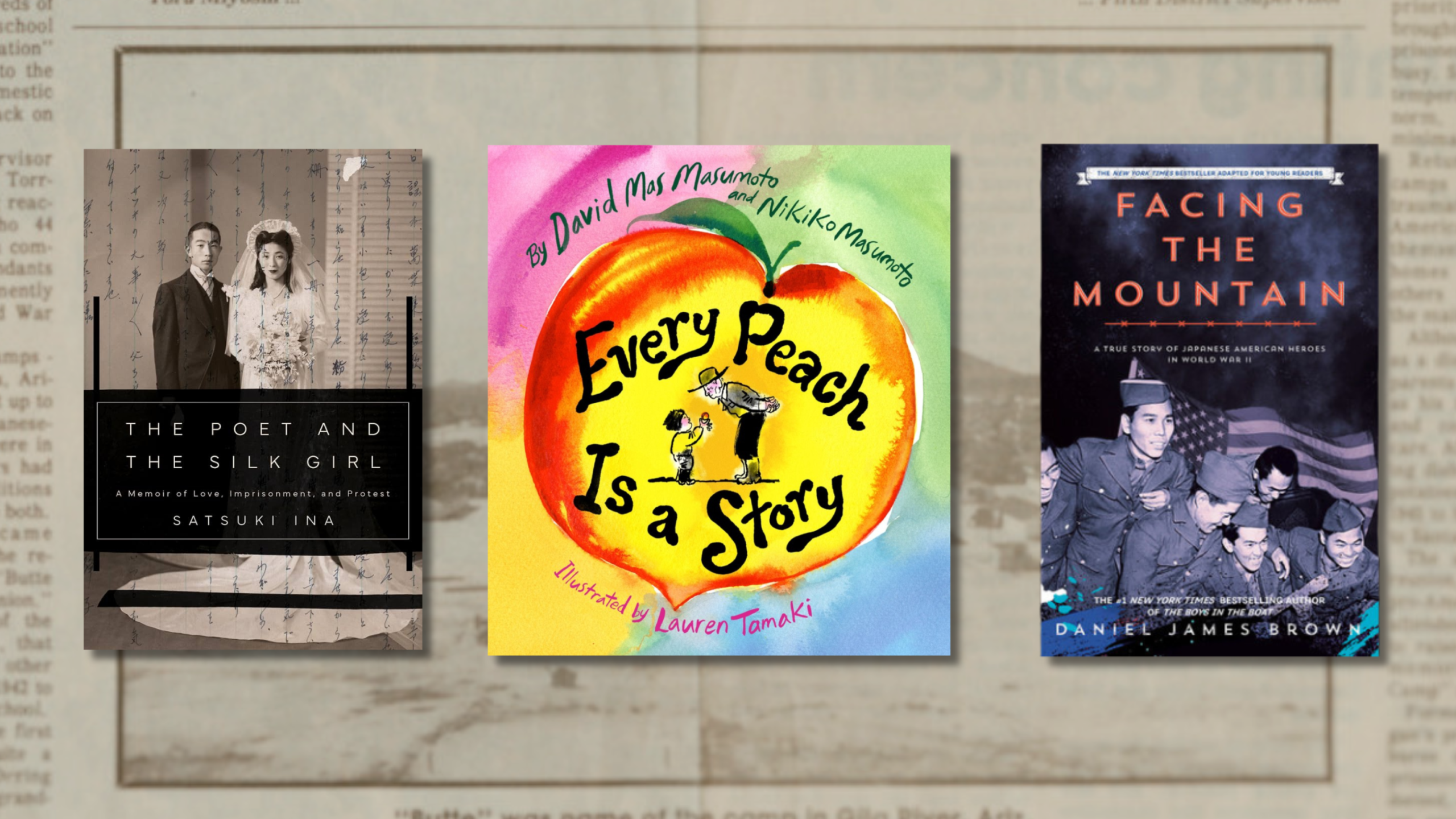
This summer, Densho staff reviewed children’s and young adult books about Japanese American incarceration, evaluating each book for both historical accuracy and an anti-bias lens. These reviews are intended to help educators, families, and caregivers choose age-appropriate books about the WWII incarceration and related themes with care and context. Each review includes an overall assessment, along with notes on the book’s strengths, limitations, and considerations for classroom or family use.
Elementary
A Line Can Go Anywhere
Written by Caroline McAlister and illustrated by Jamie Green
Overall Assessment: Recommend
Reviewed by Caitlin Oiye Coon, Archives Director
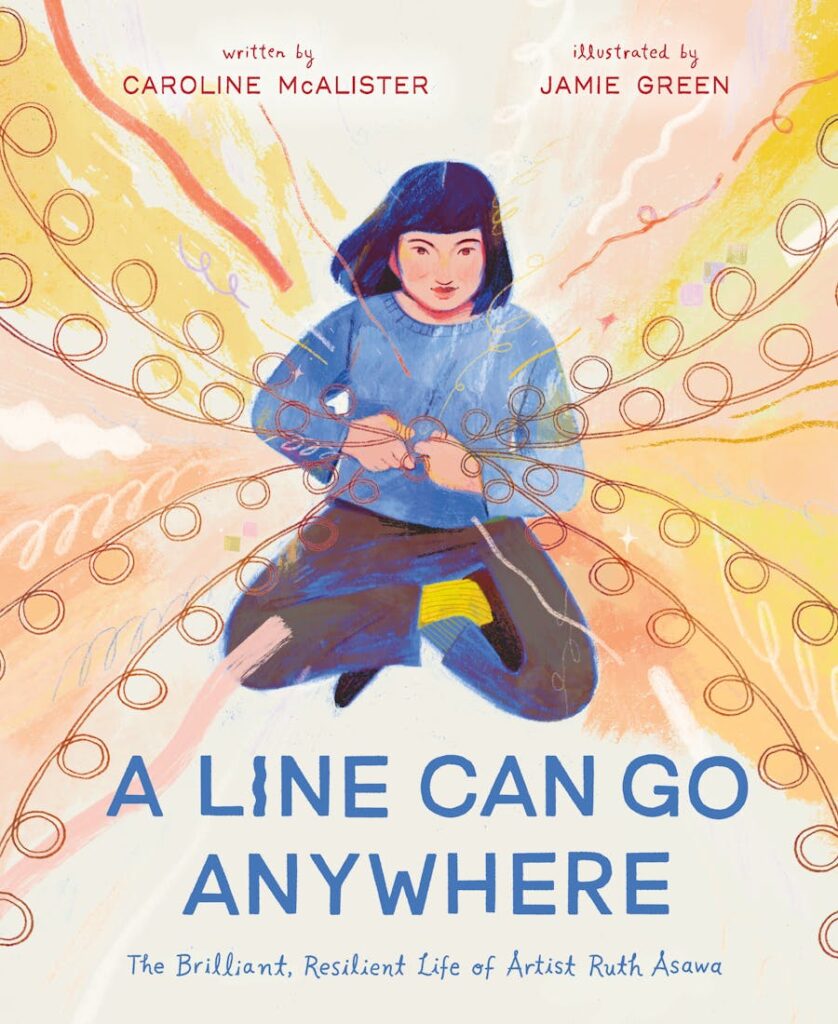
A Line Can Go Anywhere, written by Caroline McAlister and illustrated by Jamie Green, is an engaging picture book for children ages 4–8. It tells the story of Ruth Asawa, the daughter of Japanese immigrant farmers, who was incarcerated at the Rohwer concentration camp during World War II, and who later became a celebrated artist and passionate advocate for arts education. Beautiful illustrations and compelling storytelling make this book an excellent choice for young readers.
Ruth’s story resonates with readers of all ages. The book offers elementary age children entry points for engaging their interest in art while also teaching them about racism and the World War II incarceration of Japanese Americans. Children learn how Ruth found inspiration in basic objects and everyday tasks and how she would not let obstacles like racism, confinement, sexism, or social expectations deter her love of artistic expression. The theme of art runs through the whole book and creates a continuity through the history of Japanese immigration, incarceration, post-war resettlement, and modern day reflections on past trauma. McAlister presents these complex historical events with honesty and from an anti-bias lens, while keeping the concepts accessible and age-appropriate for young children.
Given the breadth of Ruth’s life, the author does an impressive job of distilling the key moments in her story down into a picture book format. Readers learn about everything from her childhood on the farm and the family’s displacement to her education at Black Mountain College and her art career and activism. Each part of that story is important for readers to learn about issues of racism, injustice, identity, resilience, and the transformative power of art.
Although the book is meant for a younger audience, older children and even adults will enjoy learning about Ruth’s life and thinking about more complex ideas around identity, trauma, and the accessibility of art for everyone. At the end of the book, there is an extensive author’s note and a list of other resources for adults who may want to learn more about Ruth.
A Line Can Go Anywhere truly shines in the way McAlister and Green bring Ruth’s artistic vision to life through both words and illustrations. Flowing, wavy lines paired with descriptive language, such as “curved,” “arched,” and “stretched,” evoke the delicate wire sculptures for which Ruth Asawa is best known. By the end of the book, readers see how her experiences, from childhood on the farm to incarceration and beyond, influenced both her art and her lifelong commitment to creativity and community.
To learn more about Ruth Asawa check out these resources:
- Ruth Asawa, Densho Encyclopedia
- Santa Anita (detention facility), Densho Encyclopedia
- Rohwer, Densho Encyclopedia
- “Visionary Sculptor Ruth Asawa” Densho Catalyst
- A Tribute to Ruth Asawa, film by Dianne Fukami
- Invitation to San Francisco School of the Arts annual event, “Event of the Year”
Every Peach is a Story
Written by David Mas Masumoto and Nikiko Masumoto, illustrated by Lauren Tamaki
Overall Assessment: Recommend
Reviewed by Maya Hayashi, Event Manager
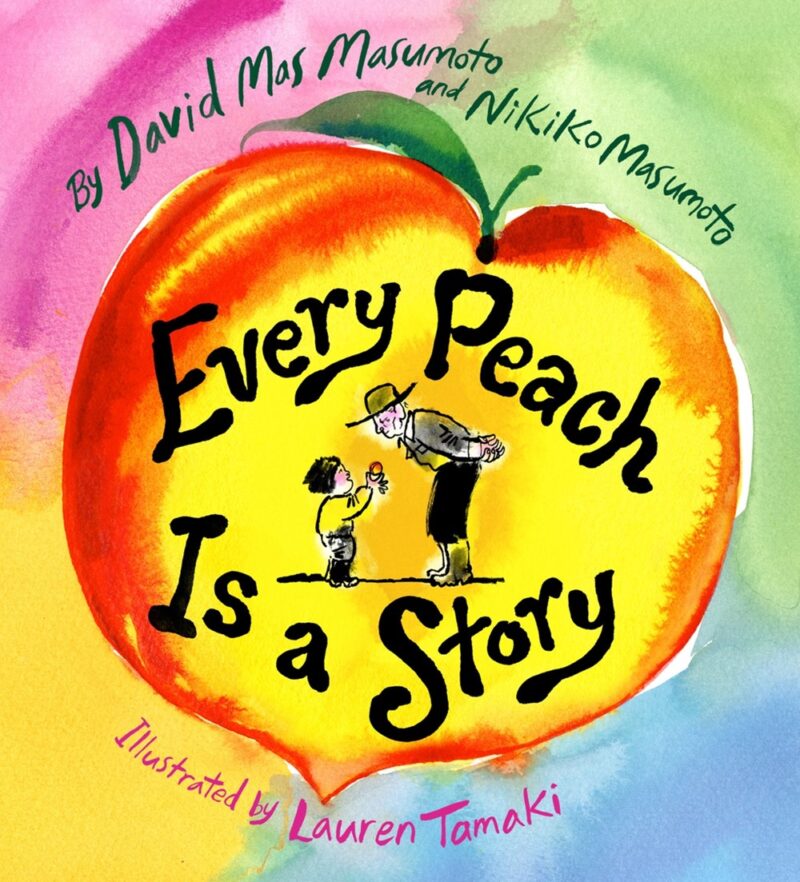
Every Peach is a Story shares a Japanese American family’s story through a metaphor of a peach and its lifecycle. Told through dreamy watercolor illustrations and prose, the storybook shares lessons that Midori (the main character) learns from her grandfather, or Jiichan. As the seasons change, and as their peach farm bears fruit, she and her grandfather walk along the rows of peach trees. They honor the labor, the workers, food systems, and family members who have supported their farm. Midori learns how time and memory have shaped her family, and she understands that their family’s American story mirrors a peach growing from green and unripe to juicy, ripe, and perfect. Time passes with Jiichan growing older and Midori cherishing his lessons, even after he is no longer around.
Lauren Tamaki’s illustrations evoke wonder and play as watercolor memories float around Midori as she follows her grandfather in their peach grove. Depictions of their immigration journey, their wartime incarceration experience, a family altar, and Obon dancing all reflect their Japanese American identity and embed the story with cultural motifs familiar to Nikkei readers. Through those evocative images, a portrait of a family’s resiliency emerges. Japanese American incarceration during WWII is framed by how it affected her family; it serves to inform her family’s story but does not define it.
Every Peach is A Story would be a boon to teachers or families first introducing Japanese American incarceration history to their students or children. The images provide opportunities to spark conversations about Japanese American Incarceration. While the history is not explicitly detailed within the body of the story, readers can refer to the Author’s note that provides accurate and age-appropriate context about WWII incarceration, alongside a description of the authors’ family’s own wartime experience. For me personally, as a Yonsei reader, the book’s illustrations evoke my own memories of my relatives and the farmland they cultivated. Jiichan’s outfit is a perfect carbon copy of the clothes my hardworking grandfather wore. In Every Peach is a Story, Japanese American heritage is shared in subtle but profound ways, and history is grounded in lived experience.
Educators can supplement this book with the following resources from the Matsumoto family website:
- Changing Season: On the Masumoto Family Farm (film) – Densho Resource Guide
- Masumoto Family Farm Website
- Free Lesson Plan on Every Peach is A Story from the Masumoto Family Farm Website
Wat Takes His Shot: The Life & Legacy of Basketball Hero Wataru Misaka
Written by Cheryl Kim and illustrated by Nat Iwata
Overall assessment: Recommend with caveats
Review by Miya Schilz, Digital Content Coordinator
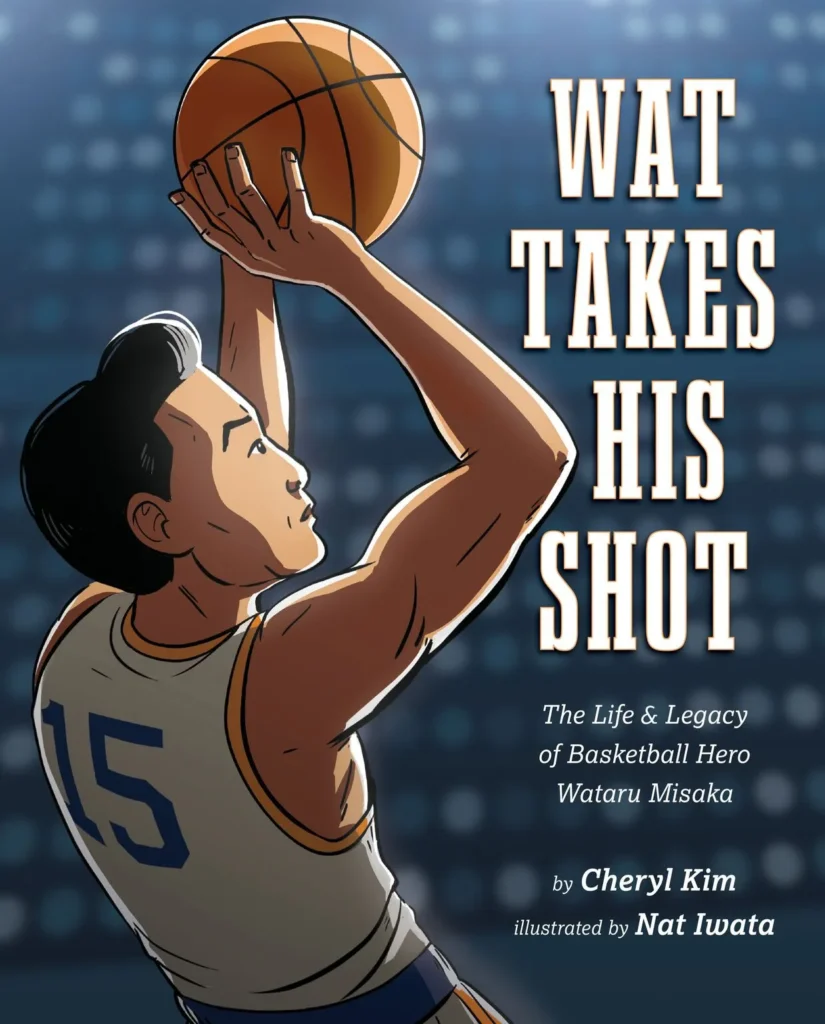
Lately, everyone can’t stop talking about the “Knicks in five!” and the team’s historic win at the 2026 NBA Championship. But did you know that former Knicks player Wataru Misaka was the first person of color to play in the NBA? In the picture book Wat Takes His Shot: The Life & Legacy of Basketball Hero Wataru Misaka, author Cheryl Kim and illustrator Nat Iwata tell the story of Wataru’s – or Wat’s – life from childhood through adulthood, including Japanese American incarceration and key moments that led to his significant basketball career. The book describes his struggles and resilience in the pursuit of his dream of playing basketball at a professional level despite encountering racism, losing his father, and World War II. While the book primarily focuses on depicting his life, it also effectively provides examples of complex concepts for young children, including how racism impacted his life before, during, and after World War II. Additionally, Wat Takes His Shot provides a good entry point for elementary-age children and basketball fans alike to be introduced to Japanese American incarceration history through the retelling of Wataru Misaka’s story.
Although Misaka was not incarcerated, Wat Takes His Shot briefly describes key points in Japanese American incarceration history, including Pearl Harbor and the forced removal of Nikkei people into incarceration camps. However, it does not mention all the reasons why Executive Order 9066 was signed. Although the book calls attention to President Franklin D. Roosevelt signing Executive Order 9066, the book promotes a common narrative that this decision was based solely on an increase in wartime fear fueled by racism after Japan’s attack on Pearl Harbor. While racism played a large part, this narrative excludes other contexts, such as the economic and political motives to remove and incarcerate the roughly 120,000 Japanese Americans along the West Coast. Despite this omission, the book offers a good general overview of this history and its complexities—which is especially difficult to do in a limited page count and for young children.
This book is also well researched and references various primary source materials. It is, however, notable that the listed resources focus primarily on Wataru Misaka and his basketball career rather than Japanese American history more broadly. Nat Iwata’s illustrations are captivating and utilize perspective, inset drawings, and contrasting colors to visually convey the emotions of Wat in a given moment. For the intended audience, the illustrations not only complement the text but also further help communicate complex concepts and emotions. Additionally, Iwata depicts Nikkei as individuals, not as a monolith.
Overall, Wat Takes His Shot spotlights a lesser-known figure in American basketball and Japanese American history. It characterizes Wat well, both in the text and illustrations, by highlighting his perseverance and gambatte, or “do your best,” spirit through many life obstacles. It is an overall uplifting story. While it could be better at providing more historical context, particularly in the author’s note, it balances the need for historical accuracy and the needs of the intended audience.
We recommend that educators pair this book with some of the following resources:
- Publisher Lee & Low Books Inc.’s Teacher’s Guide
- Japanese Americans in military during World War II – Densho Encyclopedia Entry
- Topaz – Densho Encyclopedia Entry
- Executive Order 9066 – Densho Encyclopedia Entry
- December 7, 1941: Pearl Harbor Attack – Densho Encyclopedia Entry
- Japanese Americans in Utah – Densho Encyclopedia Entry
- Introduction to WWII Incarceration – Densho Multimedia Resource
Middle School
Days of Infamy: How a Century of Bigotry led to Japanese American Internment
By Lawrence Goldstone
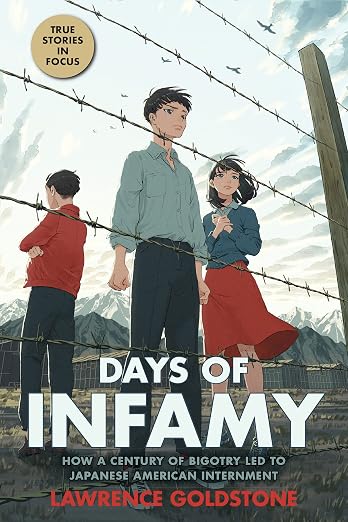
Overall Assessment: Recommend with caveats
Review by Densho Staff
The book’s greatest strength is the broad historical context it provides: Goldstone situates Japanese American incarceration during World War II within a longer history of anti-Asian racism, including exclusionary laws and government policy. The book helps young readers see that incarceration did not happen suddenly or in isolation, and it is useful for helping students understand the legal, political, and racial systems that shaped the incarceration. However, the cover’s image of Japanese Americans behind barbed wire also suggests a book more directly centered on incarceration than the text actually is.
Despite the important historical context this book provides to the incarceration, it leaves out a human-centered account of anti-Asian exclusion and racism in addition to Japanese American incarceration. The narrative largely centers white politicians and government officials, while Asian Americans often appear briefly and with limited context, especially compared to their white counterparts. Japanese Americans who experienced forced removal and incarceration are briefly included, but their stories tend to pop in and out without enough attention to their lives, communities, choices, or resistance. More oral histories, first-person accounts, and Japanese American community perspectives would have added needed depth. The book also does not appear to draw deeply from Japanese American scholars, organizations, or community-based expertise, which contributes to a sense of distance from the people most affected. Because of this, the book can feel dense and a little dry, especially for students who are looking for a more personal or narrative-driven account.
There are also some terminology and historical framing concerns. Despite being a recent publication, the book uses the word “internment,” including on the cover, rather than more accurate terms such as incarceration. While the book is generally strong in explaining the broader history of racism and exclusion, there are minor but meaningful historical issues, such as describing Sanford Ballard Dole as having “a reputation for fairness” despite his involvement in the overthrow of Queen Liliʻuokalani and the Hawaiian Kingdom, or calling 1924 “the high point for race prejudice in the United States,” a framing that risks oversimplifying a longer and ongoing history of racism.
Overall, Days of Infamy could be useful as a foundational text for understanding the broader historical context that led to incarceration, but it should not be used as the primary or only text for learning about Japanese American incarceration. Teachers should pair it with Densho oral histories, primary sources, photographs, and resources that center Japanese American agency, resistance, community life, and memory. This book is “yellow” (recommended with caveats) for learning about the broader historical context, but would be closer to “red” (not recommended) if used alone to teach the incarceration experience itself.
Facing the Mountain: A True Story of Japanese American Heroes in World War II
By Daniel James Brown; adapted by Liz Hudson
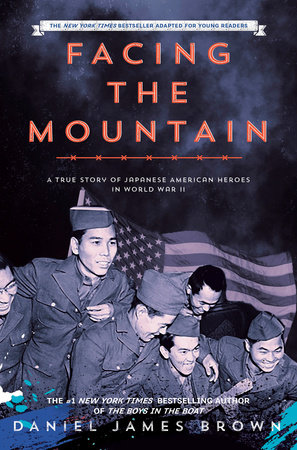
Overall Assessment: Recommend
Review by Courtney Wai, Education & Public Programs Manager
Despite being shorter and less detailed than the original, the young reader’s edition of Facing the Mountain captures the heart of the original book, connecting readers to the incarceration history through the stories of four young Japanese American men. Three of these men—Rudy Tokiwa, Fred Shiosaki, and Katsugo Miho—are all part of the famous 442nd Regimental Combat Team, and through them, readers develop a strong understanding of why Brown and Hudson would call them “heroes.” Their actions on and off the battlefield are conveyed through vivid narrative prose that captures their doubts and fears as they navigated enlistment, combat, and the challenges of returning to life after military service.
Importantly, Brown and Hudson place the fourth man Gordon Hirabayashi’s story on equal footing. Rather than serving in the military, Hirabayashi engaged in nonviolent resistance, using the courts to challenge the racism and injustice of Executive Order 9066. Given the historical stigma against draft resisters within the Japanese American community, it is significant that Hirabayashi is also framed as a hero–particularly in a book that centers Nisei servicemen. This inclusion broadens the definition of resistance and highlights multiple forms of courage.
The range of these men’s experiences offers readers an accessible yet nuanced entry point into this history. This book distinguishes between the experiences of Japanese Americans from Hawai‘i, those in the West exclusion area, and those living outside of it, while also addressing the loss, injustice, and emotional toll of incarceration of the broader Japanese American community. While necessarily condensed, the narrative avoids reducing individuals to a single storyline and instead explains how broader structural forces, such as racism and government policy, shaped their lives. Ultimately, readers come away with a deeper understanding of the lasting impact of incarceration and a more expansive notion of what “heroism” can look like.
Educators could further deepen students’ engagement by pairing the book with oral histories and resources from Densho that informed Brown’s research, allowing students to connect the narrative to firsthand accounts and engage directly with the voices that underpin the story.
High School
Kiyo Sato: From a WWII Japanese Internment Camp to a Life of Service
By Connie Goldsmith with Kiyo Sato
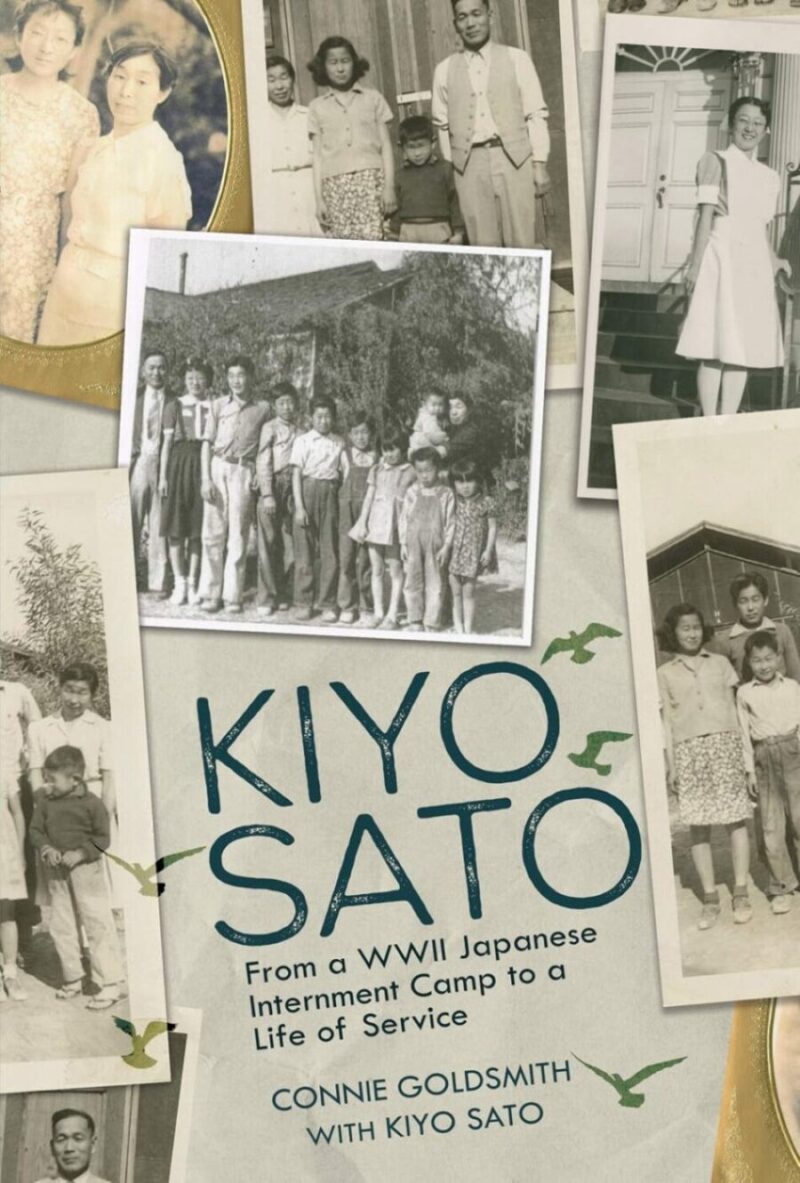
Overall Assessment: Recommended
Review by Christen Greenhill Robichaud, Processing Archivist
Aimed at high school students, this book is an excellent introduction or continuation for readers learning about Japanese American incarceration. Connie Goldsmith and Kiyo Sato write a moving account of the Sato family’s life before, during, and after World War II. Readers learn about Kiyo’s parents’ immigration story, how they met and fell in love, and their successes as farmers in California. But Kiyo is the central figure of this story, and the book focuses on the aftermath of the bombing of Pearl Harbor and her journey to Pinedale Assembly Center and later Poston Concentration Camp. Her recounting emphasizes the incarceration experience as a young woman, the opportunities she lost, and the responsibilities she felt as the oldest child. Kiyo’s story truly humanizes Japanese American incarceration for young adult readers.
An additional strength of this book is that it spends a great deal of time on Kiyo’s life after incarceration. The text clearly explains how being unjustly incarcerated changed the trajectory of her life and the lives of her entire family. After camp, Kiyo becomes a nurse with the Cadet Nurse Corps (and the inventor of the Blackbird Vision Test), a human rights activist, and a leader in the fight for reparations. Throughout these successes as an adult, she continues to share the ups and downs of her life, maintaining the personal connection throughout the book.
Kiyo’s story is the central thread woven throughout the text, but also included are links to the broader incarceration experience for Japanese Americans. Another way this book excels is in the way Goldsmith and Sato highlight the injustices of the incarceration; they do so directly in the main text, but also with inserts throughout describing the U.S. government’s actions, the use and dangers of euphemistic language, and with the addition of numerous photographs, timelines, maps, and more. Furthermore, Japanese American incarceration is told as a complex experience. The book tells of the resilience of families, how they strived to find meaning in little things, especially for their children. The Satos experience success and setbacks throughout their lives, and readers can clearly see the lasting impact of the incarceration. Kiyo Sato delves deeper into the nuances of the Japanese American experience, giving readers greater insight into what the lasting effects of the WWII incarceration truly are.
My overall assessment for Kiyo Sato: From a WWII Japanese Internment Camp to a Life of Service by Connie Goldsmith with Kiyo Sato is “green” (recommended). I think anyone interested in learning more about Japanese American history, high schooler or adult, student or expert, could benefit from reading this book.
The Poet and the Silk Girl: A Memoir of Love, Imprisonment, and Protest
By Satsuki Ina
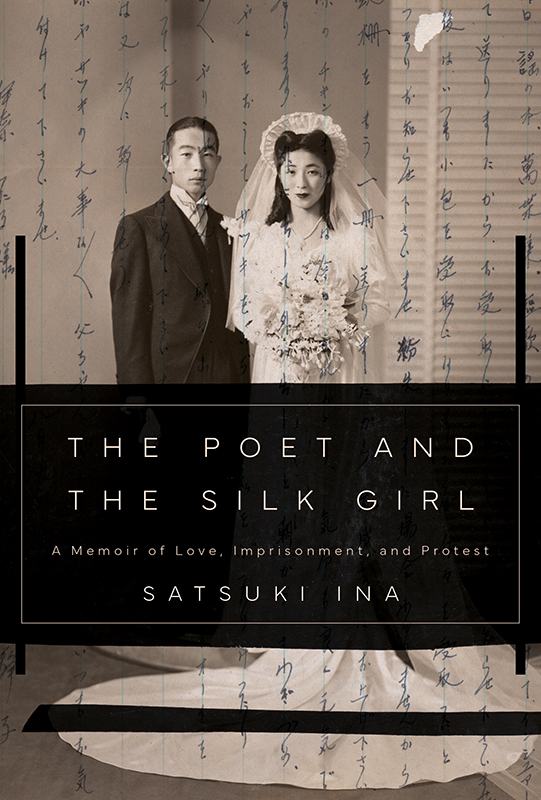
Overall Assessment: Recommend
Review by Courtney Wai, Education & Public Programs Manager
Satsuki Ina’s memoir offers a deeply personal account of Japanese American incarceration, centering intergenerational trauma and lived experience. Drawing on her work as a psychotherapist and her family’s history, she tells this story through her parents’ voices, including intimate letters exchanged between them, alongside haikus and poetry written by her father. Together, these writings capture moments of pain, joy, fear, and stress as a young newlywed couple and new parents navigating forced removal, life in various concentration camps, and the challenge of determining how to raise their family. These glimpses into everyday life make the narrative especially human and accessible. Ina also brings forward an undertold story by examining the harsh conditions of Tule Lake Segregation Center, the challenges facing renunciants, and their ongoing fight for recognition, while critiquing euphemistic language and clearly naming racism and government policy as the causes of incarceration.
True to her background, Ina foregrounds healing and trauma, connecting her family’s story to broader movements for justice, including her work with Tsuru for Solidarity and her leadership in Healing Circles for Change at pilgrimages and in immigration detention centers. The book highlights protest, legal resistance, and ongoing efforts toward repair. Her concept of the “compassionate witness” invites readers to engage with this history ethically as well as intellectually, making it especially meaningful for readers interested in mental health, trauma, and connections to present-day immigration and detention. While the book addresses adult themes, secondary students can engage meaningfully with appropriate support, and the included study and discussion guide offers thoughtful prompts and activities to help process the emotional weight of the content.
For additional information about the book, watch Densho’s recording of Satsuki Ina talking with Densho’s founding executive director, Tom Ikeda.
—