June 3, 2026
In this guest contribution, historian and PhD student Selena Moon explores the importance of accessibility at historic sites, highlighting how many sites have been and continue to be inaccessible. She explains how accessibility is often one of the last considerations at historic and other sites. And if a site has accessibility, it is often limited, excluding people with various disabilities. Selena reminds us that it is important to create spaces in which everyone feels and is included, and she offers concrete strategies for doing so. If you want to learn more, please check out this Accessibility Toolkit with more specific tips for increasing accessibility at historic and other sites.
Introduction
Since childhood, I have loved history and frequently visited museums and historic sites, and attended conferences. However, as a person with low vision, I have found that many locations, exhibits, and presentations are inaccessible for several reasons, including dark interiors, small text and inaccessible fonts, lack of contrast, not being able to get close to exhibits or text, and lack of accessible materials. Since getting COVID in 2024, I have also had difficulty processing lots of information and articulating words, and am more aware of how videos and other audio and oral media may be inaccessible, especially in loud environments. I am also more aware of how inaccessible many places are for people with mobility issues and/or fatigue.
Over the last few years, I have learned a lot about accessibility, especially from fellow Disabled Academic Collective (DAC) members. Some people prefer person-first language (a person who is blind) or disability first language (a blind person) and have different preferences and needs for font type, color, lighting, and other forms of accessibility. For example, I prefer “disabled person” and black Arial font on a white background. I generally refer to myself as visually impaired rather than low vision, but understand that not everyone likes that terminology. I have taught about accessibility, for conference presentations and historic sites and museums, which can also be used for other venues. It has been gratifying to hear that the presentations are useful and to see others using what they learned.
Historically, the world was inaccessible to disabled people in many ways, from lacking ramps or seating, sign language interpreters or subtitles, braille or large print, or having over-stimulating environments. It is important to acknowledge that disabled people were excluded from many locations, including because of lack of accommodations and accessibility. But it is also important to show how things have changed as people became more aware of and attuned to various needs, thereby decreasing these barriers. But many more remain. It has been disappointing to see how many sites remain relatively inaccessible thirty-five years after the Americans with Disabilities Act (ADA), including museums, historic buildings, and National Historic Sites.
Historian Catherine Kudlick’s 2005 article, “The Local History Museum, So Near and Yet So Far,” details a trip she and a friend took to a small museum. Kudlick has low vision, and the friend is blind. Not only was the staff ignorant and flippant, but they had no idea how to interact with blind people (giving detailed directions, for example), and were dismissive of disabled people and the difficulties they face. Kudlock also imagined a conversation with the hotel concierge, including many tropes involving blind people (don’t grab blind or low vision people without warning). Kudlick discusses the benefits of audio tours, including having directions (something I had oddly never thought about or heard of) and how to help blind and low vision people access materials, including audio players. I have experienced many of the same frustrations and instances of inaccessibility that Kudlick mentions.
Kudlick explains that only a small portion of people have been blind since birth and appreciate aesthetics, and good verbal descriptions allow patrons to enjoy things as much as fully sighted people. The article also mentions tactile exhibits and Braille labels. While Kudlick’s article focuses on blind people visiting art museums, everyone deserves access to culture and history, especially their own.1
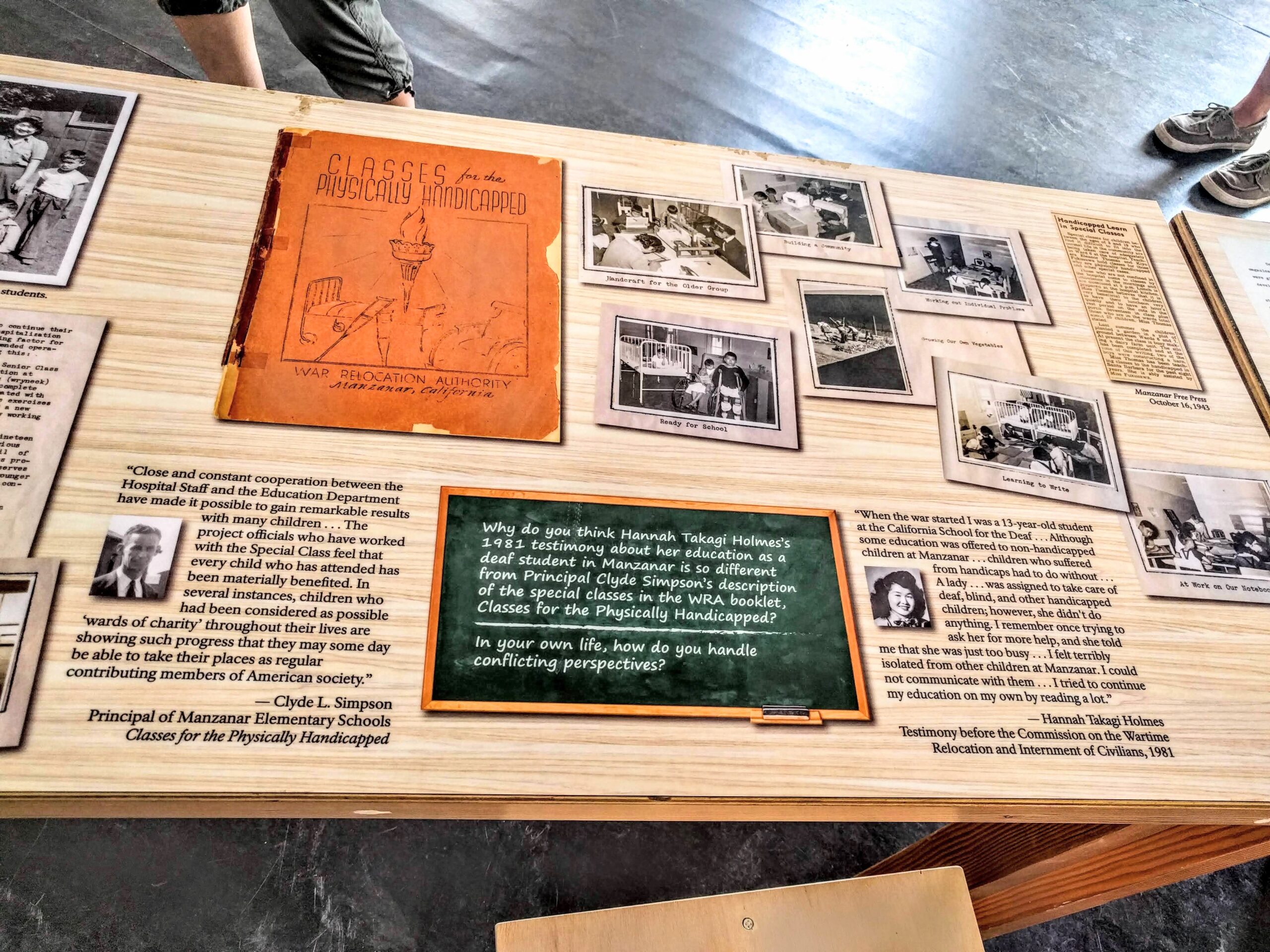
[Image description: Table displaying disability education at Manzanar. On the left are two photos and a document, mostly cut off. In the middle, at the top is the orange cover of ‘Classes for the Physically Handicapped’ booklet with a drawing of a room with a bed in the background and lit torch in the foreground. To the right are seven photographs of disabled children in class and hospital. In the top right corner is a newspaper clipping, Handicapped Learn in Special Classes, from the Manzanar Free Press. In the foreground on the left is a photo of a White man with short hair in a suite beside a quote: Close and constant cooperation between the Hospital Staff and the Education Department have made it possible to gain remarkable results with many children…The project officials who have worked with the Special Class feel that every child who has attended has been materially benefited. In several instances, children who had been considered as possible ‘wards of charity’ throughout their lives are showing such progress that they may some day be able to take their places as regular contributing members of American society. Clyde L. Simpson, Principal of Manzanar Elementary Schools, Classes for the Physically Handicapped. To the right is a photograph of a young Japanese American woman with permed hair next to a quote, ‘When the war started I was a 13-ear-old student at the California School for the Deaf…Although some duration was offered to non-handicapped children at Manzanar…children who suffered from handicaps had to do without…A lady…was assigned to take care of deaf, blind, and other handicapped children; however, she didn’t do anything. I remember once trying to ask her for more help, and she told me that she was just too busy…I felt terribly isolated from the children at Manzanar.’ Hannah Takagi Holmes. Testimony before the Commission on the Wartime Relocation and Internment of Civilians, 1971. Between the two quotes and pictures is an image of a chalkboard with text ‘Why do you think Hannah Takagi Homes’s 1981 testimony about her education as a deaf student in Manner is so different from Principal Clyde Simpson’s description of the special classes in the WRA booklet, Classes for the Physically Handicapped?’. In your own life, how do you handle conflicting perspectives?]
Accessibility and Historic Accuracy
There continue to be many discussions about accessibility versus historical accuracy. The online Inclusive Historian’s Handbook, which the American Association for State and Local History (AASLH) and the National Council on Public History (NCPH) co-sponsored, includes Cynthia Falk’s chapter “Accessibility.” It discusses the shift from “accessible” meaning multi-lingual offerings, affordability, and other considerations, to ensuring that disabled people can also access venues. Accessibility is usually thought of as being for physically disabled people, with the common symbol being a person in a wheelchair, emphasizing elevators and restrooms, without considering the range of disabilities and accessibility needs.
Accessibility and ADA compliance can be difficult for historic sites and buildings. As Falk explains, while they are not forced to adopt measures that would harm sites, not doing so “harkens back to a period of widespread discrimination before universal civil rights in the United States,” and the “goal at historic properties should be for all visitors… to have the same positive experience.” The article discusses Universal Design (UD), encouraging sites to “exceed” Americans with Disabilities Act (ADA) standards. The “standard” designed for an adult male body is not appropriate for everyone. UD is different, between being fully accessible from the start and making alterations to existing designs to be accessible, and by forcing users to adapt or find solutions.
Some who object to accessibility cite cost and historical inaccuracy. While it might be expensive to modify existing buildings, the benefits will be significant. More people will have access to the site leading to higher earnings. Objections include lack of historical value, accuracy, and cost, but these are largely inaccurate assumptions. In reality, new construction may be more expensive than restoration. Second, although old buildings are not suited for accessibility, there are many ways to add accessibility features, through reuse or adaptation, such as adding elevators, accessible bathrooms, and stairs. Third, “historic” buildings can be changed. Significant changes may be made even with historic preservation laws. Lastly, historic buildings and complying with the ADA can be compatible. Historic properties can be accessible while minimizing changes to its character.
It can be done. Historic sites of varying ages across the world have achieved accessibility. Accessibility in historic sites with original structures is likely difficult but usually not impossible. Sites with reconstructions or replicas instead of original structures have a much easier time and no excuse not to be accessible. Ramps don’t just help people who use mobility devices, but also families with strollers, just as anti-slip/safety tape or paint helps all kinds of low vision people, including people wearing progressive lenses. Historic sites from the Colosseum (partially wheelchair accessible) to the Tower of London (wheelchair, tactile exhibits, British Sign Language, audio guides, subtitles) and Cahokia Mounds State Historic Site in Illinois (wheelchair, tactile exhibits, audio tours) are somewhat accessible. However, many barriers remain.
I wrote a chapter in An Accessible Past: Making Historic Sites Accessible, about how Japanese American incarceration sites, especially Manzanar, were inaccessible as detention sites during World War II and remain inaccessible to many people today. I consulted acquaintances with various disabilities and learned a lot about accessibility and solutions that I had not thought of. I haven’t been back to Manzanar since 2019, but while writing my book chapter on accessibility, I found that they had created an Accessibility Self-Evaculation and Transition Plan in 2017. I was impressed with the depth and attention to details. The study was completed in 2022 and another website had a brief description, including photos of the tactile models of the barracks, although the page lacks alternative text. Alternative text, or alt text, is a description added to visuals allowing low vision and blind people to know what is being shown. This includes an image description and text transcription.
The Molly Brown House Museum addresses accessibility and how the ADA requires accessibility that is “readily achievable,” cheaply and easily, including grab bars and ramps, unless the “historic significance” might be compromised. This museum installed a lift instead of an elevator, which would have destroyed significant portions of the building. Budget constraints don’t mean that accessibility can’t be achieved. There are many other options, including sensory friendly exhibits, videos, and tactile exhibits. Most importantly, “The ADA is the start line, not the finish line, when it comes to accessibility,” and there is always room – and need – for improvement.”
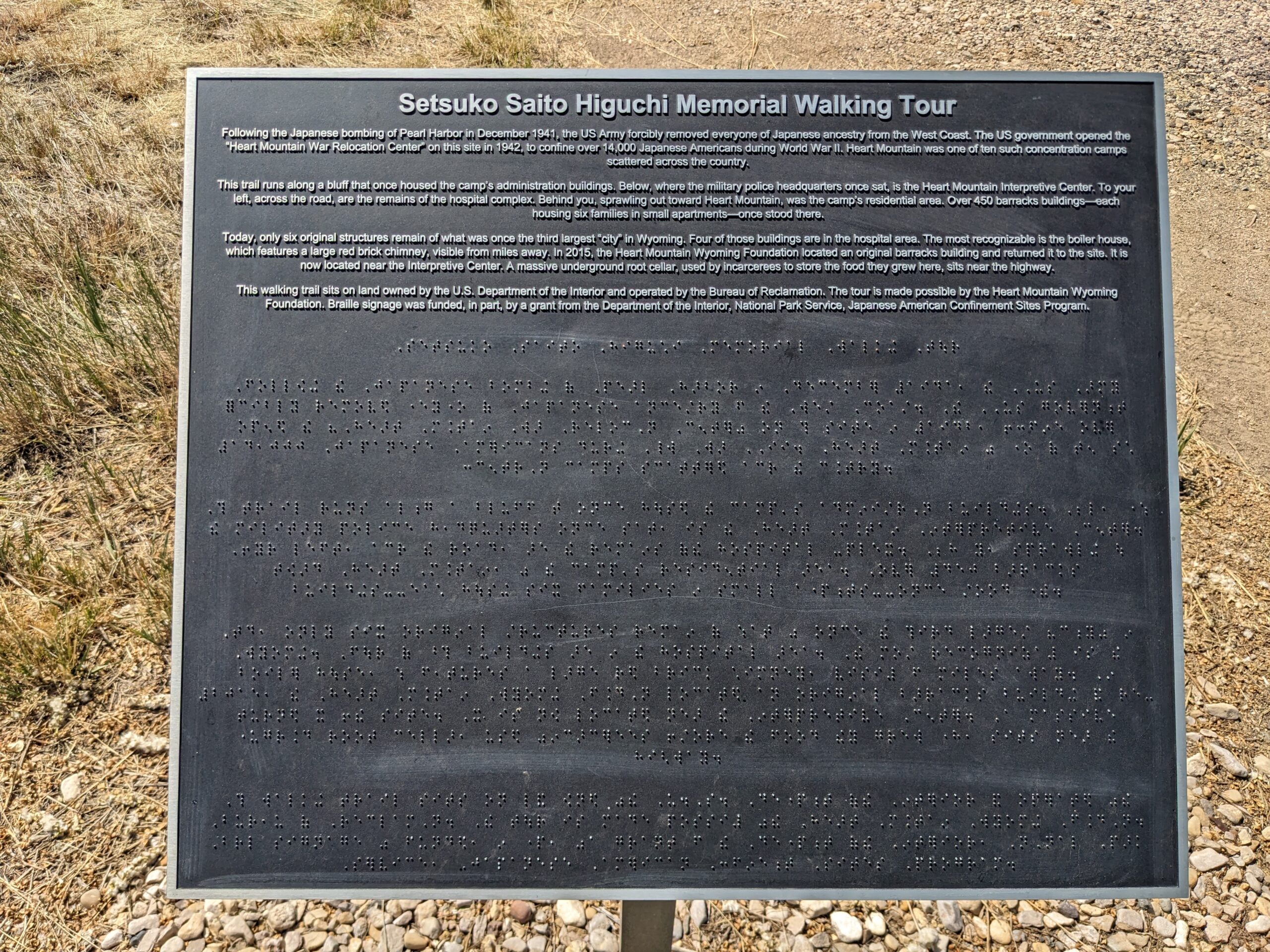
[Image description: An interpretive sign at Heart Mountain with text with braille transcription below. Setsuko Saito Higuchi Memorial Walking Tour. Following the Japanese bombing of Pearl Harbor in December 1941, the US Army forcibly removed everyone of Japanese ancestry from the Wet Coast. The US government opened the “Heart Mountain War Relocation Center” on this site in 1942, to confine over 14,000 Japanese Americans during World War II. Heart Mountain was one of ten such concentration camp sites scattered across the country. This trail runs along a bluff that once housed the camp’s administration buildings. Below, where the military police headquarters once sat, is the Heart Mountain Interpretive Center. To your left, across the road, are the remains of the hospital complex. Behind you, sprawling out toward Heart Mountain was the camp’s residential area. Over 450 barrack buildings-each housing six families in small apartments-once stood there. Today, only six original structures remain of what was once the third largest ‘city’ in Wyoming. Four of those buildings are in the hospital area. The most recognizable is the boiler house, which features a large red brick chimney, visible from miles away. In 2015, the art Mountain Wyoming Foundation located an original barracks building and returned it to the site. It is now located near the Interpretive Center. A massive underground root cellar, used by incarcerees to store the food they get here, sits near the highway. The walking trail sits on land owned by the U.S. department of the Interior and operated by the Bureau of Reclamation. The tour is made possible by the Heart Mountain Wyoming Foundation. Braille signage was funded, in part, by a grant from the Department of the Interior, National Park Service, Japanese American Confinement Sites Program.]
Strategies for Increasing Accessibility
There are many ways to make spaces accessible. A great template is the Ingenium Accessibility Standards For Exhibitions, which provides details about the museum’s accessibility standards. Most of the document and images relate to physical accessibility, but there are also details about accessibility for low vision, blind, and d/Deaf people. There were many things that I hadn’t thought of, such as the shape and types of controls, as well as time stamps for closed captioning.
Accessibility and universal design creates a safe and inclusive environment for everyone. No one is able-bodied throughout their lives. Multiple ways of accessing information can benefit many groups. For example, a video with audio and captioning can help low vision people or d/Deaf or hard of hearing people. Simple language can help various people, from a non-native speaker and intellectually disabled people or people with communication disorders. Similarly, curb cuts (the sloped section of a sidewalk leading to the street) are useful for people who use wheelchairs, walkers, strollers, and other mobility devices, but also for low vision people who have difficulty with depth perception.2
Anyone can become disabled at any time, from accidents, old age, and sickness. Just because someone might not need accessibility now, doesn’t mean they won’t later. But most able-bodied people do not think about this and even criticize accessibility.
In 2023, while writing my article about historic site accessibility, I found two blog posts. One listed wheelchair accessible sites, which I believe included Manzanar. This surprised me, given what I had heard from others who had attempted to navigate the site with wheelchairs. The other was a blog post about the author visiting an incarceration camp site. They noted that the ramps installed were not historically accurate. I was torn between seeing this as a historian and a disabled person and activist, but mostly it made me angry. Historic sites must be accessible, and it is important to acknowledge that they weren’t at the time, and in many cases took a long time to become accessible, or continue to be inaccessible.
Without accessibility, disabled people are once again excluded and unable to learn about and experience the world. It is also important for non-disabled visitors and employees to understand accessibility, or lack thereof, not only historically but also in the present.
Accessibility is the law. Minimally accessible isn’t enough. Having it as an afterthought isn’t enough. Creating accessible spaces benefits everyone, not just disabled people, and makes spaces more inclusive. Consult disabled people and involve us in the process! Include our stories. It’s ok to make mistakes, but it’s important to learn from them too!
If you want to learn more, please check out this Accessibility Toolkit with more concrete tips for increasing accessibility at historic and other sites. It includes examples of accessible spaces, displays, and activities; and additional resources and readings for further learning. We all have a role in making our public spaces more accessible, and I hope these tips and strategies can offer a good place to start.
Some accessibility needs may conflict, also known as what Liz Jackson calls “access friction.” Access friction originally referred to disabled people having difficulty navigating environments that aren’t built for them, or when their access needs aren’t met. It has evolved to refer to situations when people with different disabilities have needs that conflict with another person or group’s needs.3 These tips don’t cover everything, but hopefully they provide a good overview and starting point.
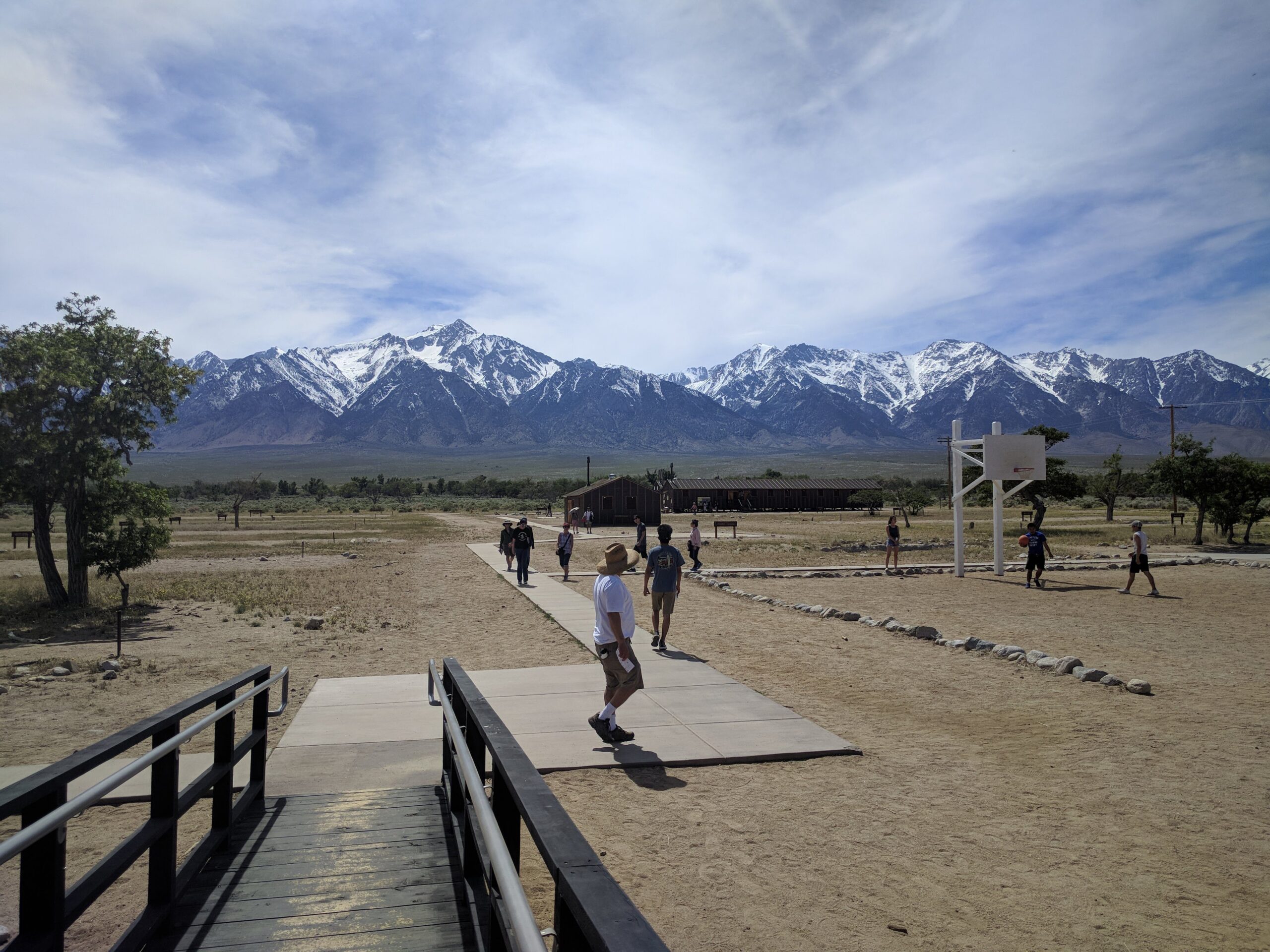
[Image description: Ramp leading to the paved walkway at Manzanar with several visitors walking arnd mountains in the distance.]
Notes
- Catherine Kudlick, “The Local History Museum, So Near and Yet So Far,” The Public Historian 27, no. 2 (2005): 75–81. ↩︎
- For more information, see Angela Glover Blackwell, “The Curb-Cut Effect (SSIR),” Stanford Social Innovation Review, Winter 2017, https://ssir.org/articles/entry/the_curb_cut_effect. ↩︎
- For a brief explanation see the Accessagogy Podcast “Access Friction” episode which covers the definition, but focuses on accessibility in teaching. It includes a transcript and links for more information. For a more in-depth podcast with see Liz Jackson, guest, Changing the Disability Design Narrative, Season 2, Ep. 25, hosted by Leigh Allen-Arredondo, UX Cake, January 14, 2019, https://shows.acast.com/uxcake/episodes/changing-the-disability-design-narrative. Website might not be completely accessible to visually impaired users. Includes transcript. ↩︎
—
Guest contribution by Selena Moon.
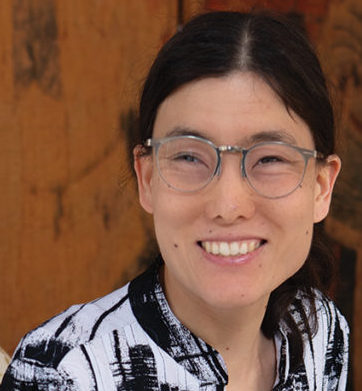
Selena Moon is a disabled public historian and writer based in Minnesota, and a PhD student in American Studies at the University of Minnesota Twin Cities Her research interests include multi-racial, disability, and women’s history. She researches Japanese American mixed race and disability history. Her research currently focuses on the disabled Japanese Americans and their families during the World War II incarceration.
This article was made possible through the support of a National Park Foundation grant.