May 18, 2026
In this guest contribution, UCLA PhD Student Amber Hisatomi reviews Karen Tei Yamashita’s new novel, Questions 27 & 28. The book captures the movement and history of Japanese Americans from the 20th century to the present through the involvement of real historical figures and experimental narratives. The novel plays with the concept of loyalty in Japanese American history in unexpected yet connected ways. Tying in the literary and the personal, Amber explores the novel as an archive through a brief overview of its three parts, focusing on how communities are empowered by shared histories, especially when able to contribute to it.
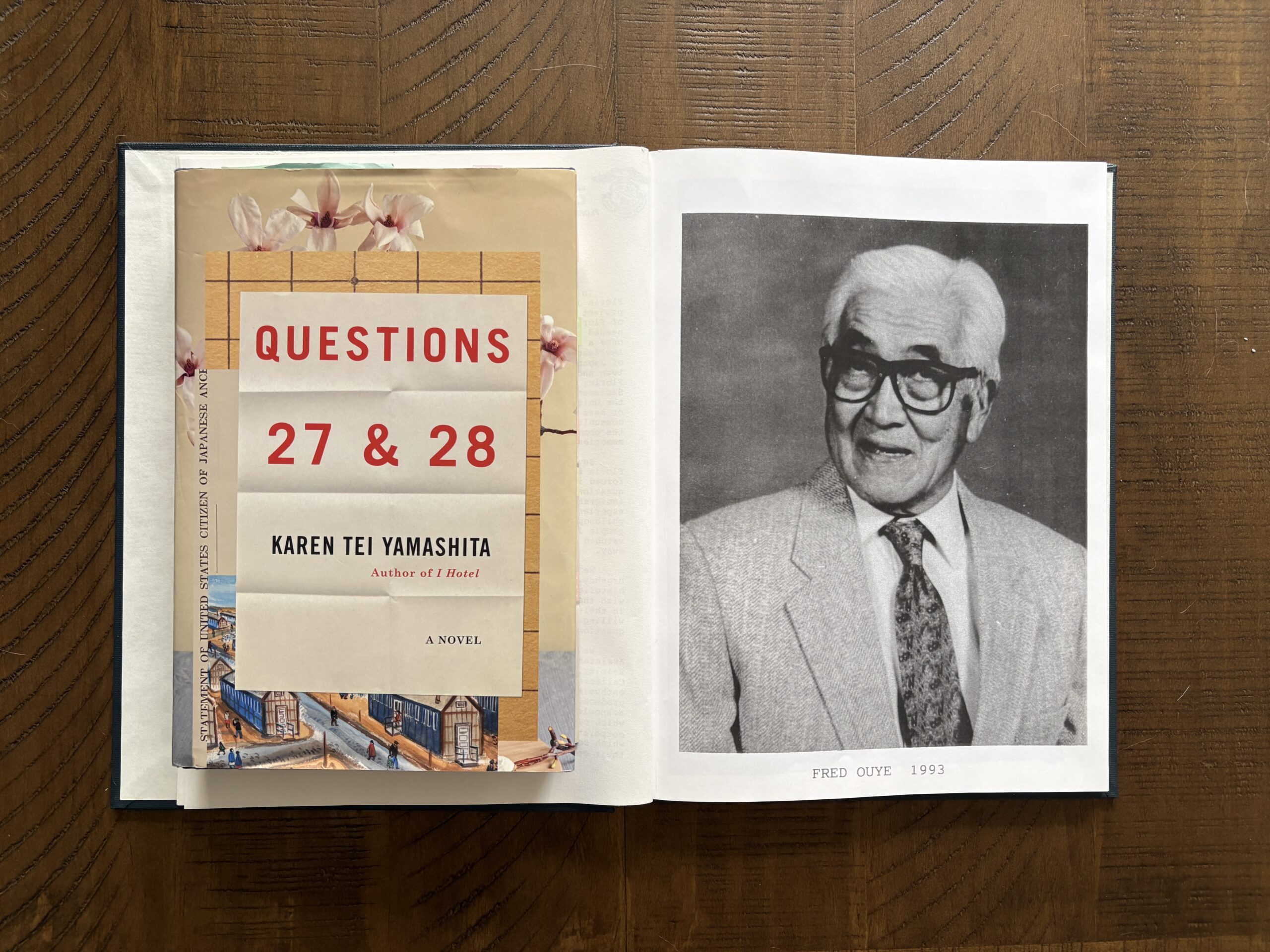
The summer before I left for graduate school, I was shuffling through the books on my shelf; it was something I did often throughout my gap year, since I had an overabundance of free time and a long list of novels that remained untouched. But one afternoon, as my eyes skimmed each spine, they stopped on a book with a tall build and a gold title. And, it had my late great-grandfather’s name on it: Fred Ouye.
It wasn’t the first time I’d seen it, but it was the first time I’d ever pulled it from the shelf with the very tip of my index finger. There was a light layer of dust on top, but it otherwise remained sturdy in its thick hard cover. Flipping it open, I soon found that it was a transcription of an oral history he conducted for Sacramento State in 1995; he talked about his life in Florin, his daughter Carol, how he met his wife Mary, his career as a pharmacist, and briefly touched upon his imprisonment in Tule Lake during World War II.
There are an infinite number of things I would never know about him, as he would never know about me, but I came to find that wondering is normal. I’d read the books and the articles and the primary sources (and I even talked to Densho’s own Brian Niiya), but recognizing names does not always tell me who these people were: who knows what might have been left out, excluded, or deemed “unimportant”? These questions have always plagued me, and then Karen Tei Yamashita’s new novel, Questions 27 & 28, comes out, and in a stroke of luck, I was granted the great pleasure of reading and reviewing it.
Questions 27 & 28 captures a vast and evolutionary history of Nikkei movement and activity throughout the 20th century through a blend of fact and fiction. Unfortunately and expectedly, my great-grandfather is not in the novel, but it does include real historical figures and individuals, like Michi Weglyn and Aiko Herzig-Yoshinaga. Their stories and others are captured through a multimedia narrative; there are scans of letters, government records, photographs, and drawings, alongside a variety of fonts, poems, and transcriptions.
At its core, Yamashita’s novel is a literary representation of a forgotten box of files that has gotten lost in an archival labyrinth—or, in more theoretical terms, in History—and she is wiping off the dust and debris, bringing it back into the light.
“MICHI: Oh I see now. We’re in the archive…I loved the archives. I’ve come home.” (Yamashita 305).
Opening the Novel’s Three Boxes
Revealed in chapter 2.6, titled “Richard: X,” the structure of Questions 27 & 28 takes inspiration from a trilogy of books published by the UC Berkeley’s Japanese American Evacuation and Resettlement Study (JERS); they include: The Salvage (1946, 1969), The Spoilage (1952), and Prejudice, War and Constitution (1954).
Yamashita breaks her novel into three parts, which she refers to as three “boxes,” respectively titled: “The Salvage,” “The Spoilage,” and “Residue.” Each part (or box) contains a handful of chapters that center around a specific individual, and the reader does not always learn about them through first-hand accounts, but sometimes through other people’s experiences of them or through records or unexpected narrators. Additionally, attached to each individual are thematic keywords that set expectations for the chapter.
The novel opens with “Salvage,” with narratives spanning from 1892 to 1943, and centers on the worldliness of the first generation of Japanese immigrants (Issei) who moved to the United States with the expectation that it is a place of romance, poetry, art, and beauty. Yet, alongside these Issei’s stories are tales of white Americans moving to Japan for similar reasons. There is a mutual glamorization of each others’ respective nations that arises from what is unknown and foreign. “Salvage” thus becomes the meeting point between East and West, as well as the novel’s starting point.
“One poet moves west to find the East.
Another poet moves east to find the West.” (Yamashita 11)
However, the first generation’s naivete in “Salvage” isn’t passed onto the Nisei (second generation Japanese Americans) as life in America starts to spoil.
The novel takes a turn in “Spoilage,” part two, spanning from 1942 to 1988, in which the initial feelings of romance towards the U.S. become ugly, particularly with the signing of Executive Order 9066, resulting in the incarceration of Japanese Americans across the West coast. Incarcerees were divided in their feelings towards the government that imprisoned them, some remaining “loyal” and others “disloyal.” But, what does it mean when loyalty to a nation depends on disloyalty to justice? And, what does it mean when loyalty to justice depends on disloyalty to a nation? It was questions like these that split families, friends, neighbors, and definitions of what it meant to be Japanese American on all sides.
Richard Nishimoto was a secret informant for the JERS, and his findings contributed to the “segregation of the disloyal from the loyal” and although he acknowledges, after the fact, that the “designations were complicated if not meaningless” it does not change the fact that he “helped define what happened in camp, and he would take the blame for his information, his definitions.” (Yamashita, 228)
No one was left unscathed by their time in a concentration camp, and in that regard, “Spoilage” is the perfect word. Nevertheless, when all has gone wrong, there’s nothing left to do but pick up the pieces and start again.
“Residue,” the novel’s final section, spans from 1944 to 2022, and is about returning, rebuilding, and recovering everything that has been unjustifiably taken. Inevitably, there is rage in the aftermath of incarceration, and an urgent search for accountability from the U.S. government—a nation that imprisoned its own citizens—but also a demand for reparation. All the so-called “facts” reported, including those that had been used to justify the incarceration, were not facts but rather invented.
Japanese Americans still fight for liberation, in solidarity with the struggles of other marginalized populations, and continue to call public attention to the fact that the United States did in fact have their own concentration camps. As people walk through museums and watch documentaries with looks of horror, there is remembrance.
“They forget you until they see you in the developed photos. It will be years before anyone, including you, sees your image here. Sees the beauty in your pathos.” (Yamashita, 429)
Yamashita’s novel is named after the infamous problematic questions on the WRA’s “loyalty questionnaire” for Japanese Americans, and so the concept of loyalty runs through every page of her novel, even down to the mundane. A saxophone is loyal to its player, in the same way that a wife is loyal to her husband, in the same way that Wayne Collins is loyal to justice, and in the same way a reader may feel loyal towards a novel, seeing it through to the end.
That Was The Last Box…
Yamashita provides a lot of answers, but she also leaves a lot unknown, because it is impossible to know everything. Questions 27 & 28 is an archive that genealogizes Japanese American history throughout the 20th century, and as someone who has numerous questions for my late great-grandfather, there comes a moment where one has to reconcile with what has been lost and can never be recovered, leaving the unknowable to rest.
Taking a step back, I also want to wholly acknowledge that Questions 27 & 28 is a difficult read and requires a certain threshold of trust from its reader. Upon reading the first few chapters, there are pages of Japanese, and each chapter can feel disjointed from one another. However, Yamashita’s choice of format helps emphasize how these historical figures may belong in their own separate worlds, but they are brought together through this shared history. The book is so powerful, but I can also see how it may be intimidating.
That being said, I would not describe Questions 27 & 28 as a fun or entertaining read, but I will say that it is truly a force to be reckoned with. It’s like a trust fall. The novel invites confusion and discomfort and frustration, because you may feel unsure of where it is leading you. There will likely be some flailing and Google searches, but if you trust in these characters and this history, it will catch you as it caught me.
My great-grandfather’s oral history sits on a shelf in my new studio apartment, next to my copy of Questions 27 & 28. I come home from school, toss my keys on the counter, and open my laptop, struggling to write down my thoughts for this review. So I turn back to my shelf and pick up both books, wiping any and all dust from their covers, and decide to start by simply writing about him, because he is a big reason why I do what I do. That said, I hope he can be my contribution to the shared history that Yamashita beautifully captures in her novel.
My brief summaries and thoughts barely scratch the surface of everything the book has to offer, but I have to hold my tongue. Regardless, I hope inspired readers will dive deeper and fill in the gaps for themselves!
—
Guest contribution by Amber Hisatomi
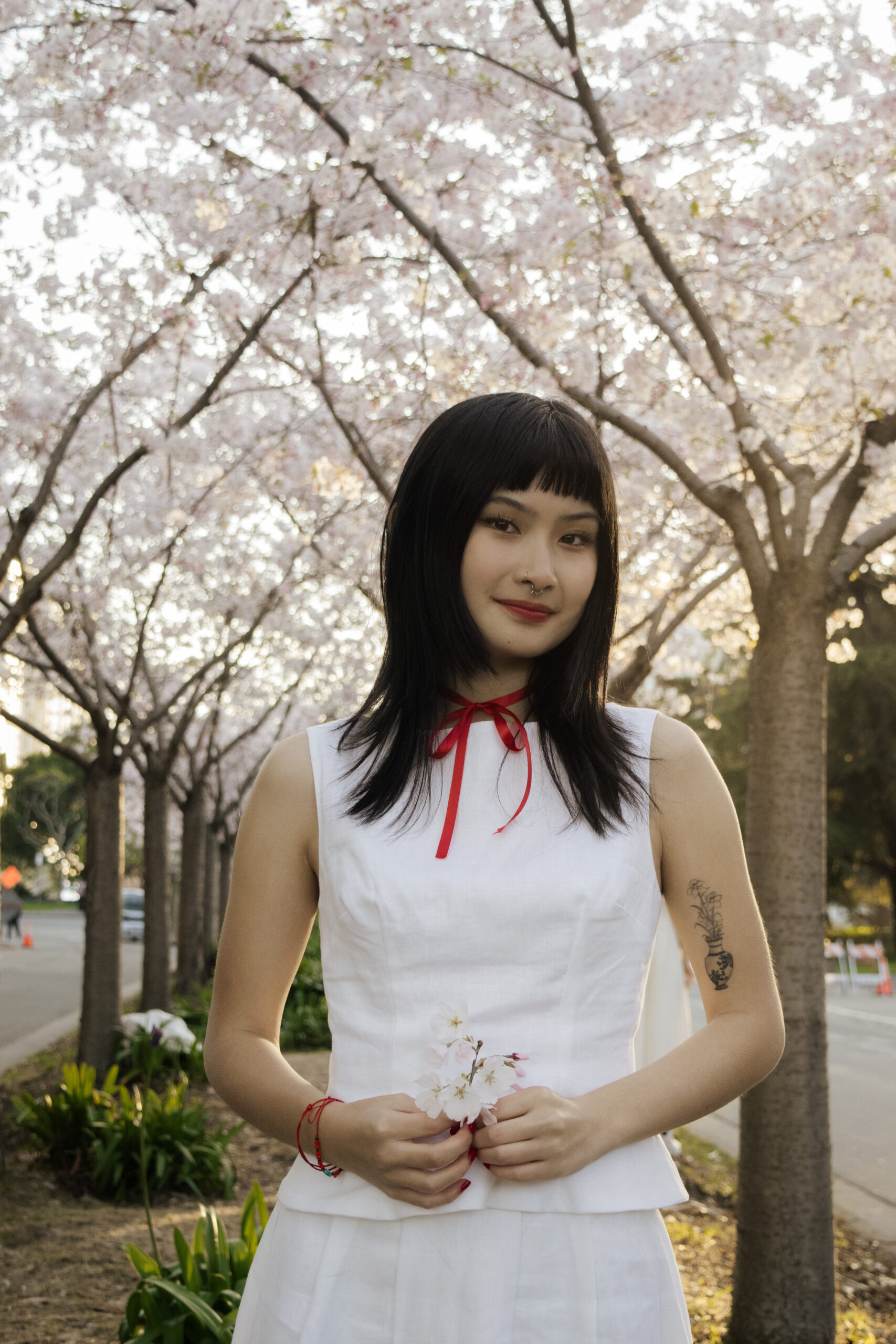
Amber Hisatomi is a first-year English PhD student at the University of California, Los Angeles. She is interested in Asian American literature, specifically Japanese American literature, techno-Orientalism, Hong Kong studies, and speculative fiction.