February 18, 2026
In this new installment of our running “Ask A Historian” series, guest writer Selena Moon—a PhD student researching Japanese American disability history and working on accessibility in various realms—explores the experiences of people with disabilities during the World War II incarceration of Japanese Americans. Sharing a general overview, as well as specific stories, Selena illuminates a crucial and largely-overlooked facet of this history. This article was made possible in part by a grant from the National Park Foundation.

Note: Several sources referenced in this article use outdated and offensive language to describe various disabilities.
Were there disabled people in the WWII incarceration camps?
Yes! People with various disabilities were incarcerated in all camps. There is little information about disabled people in camp, but they occasionally appear in War Relocation Authority (WRA) photographs and camp newspapers and more frequently medical and education records. Nobuteru Harry Sumida (Manzanar) was perhaps the oldest Nisei, born around 1871. He became disabled during the Spanish-American War (1898) and appears in two Manzanar articles and Ansel Adam’s Born Free and Equal.1 There were many others who were blind, d/Deaf,2 physically, intellectually, and multiply disabled. Unfortunately most people’s experiences are from able-bodied family, camp records, and other sources, though a few, mostly Deaf incarcerees’ have shared their experiences.
Were there exceptions?
Yes, there were some exceptions for people with severe intellectual and/or physical disabilities, as there were no facilities to care for them in the camps. Most of these individuals had been with their families until the incarceration and were forcibly institutionalized. People who were in institutions because of mental illness or intellectual disability were largely exempted and remained there through the war. Others were sent to institutions from the camps. Camp rosters and medical and social welfare files contain lists of people who were institutionalized. Several people held in institutions died before their families were released from camp.3
Children attending schools for the Deaf and Blind and other institutions were not exempt, except for Ron Hirano, the only Deaf student at the California School for the Deaf (CSD) and, so far, the only disabled student on the West Coast, to be exempt.4
Did people become disabled in camp?
Yes, through accidents and diseases such as rubella (German measles), polio, and complications during childbirth. Paul Yokote (Amache/Granada) was one of many who contracted polio. He became paralyzed and began using a wheelchair.5 Tokinobu Mihara (Heart Mountain) became blind in camp from untreated glaucoma.6

Overworked and untrained medical staff and lack of equipment caused many complications during childbirth or led to mothers and babies dying. Mabel Ota (Poston) had a difficult labor, and her daughter Madeline was born intellectually disabled and epileptic, which Mabel believes would not have happened if she had been able to have a Caesarean section.7 Camp conditions also likely exacerbated mental illness, and dozens were sent to local institutions from camp.
What were conditions like for disabled people in the camps?
Camp life was especially difficult for people with physical disabilities because of sand, stairs leading to the apartments, muddy ground, and distance to latrines and mess halls. Betty Sakurai (Minidoka) who had cerebral palsy and other disabilities and used a wheelchair, was confined to her barracks. Her brother Richard later explained, “they [presumably camp authorities] put a little porch outside the door so [Betty] could come out and be outdoors. She couldn’t go any further than that because the wheelchair wouldn’t go up and down the stairs of that porch. And if she got down to the ground, of course it was either muddy or something like that so she couldn’t leave the room.” Richard built furniture for Betty to make her life easier and more comfortable.8
Lack of medical care also led to disability. Disabled people relied on family, friends, and camp staff for meals, care, and other necessities. For instance, Tokinobu Mihara’s sons helped him navigate camp after he became blind.9
Camp conditions likely exacerbated mental illness and made mental illness and intellectual disability more visible. Approximately 150 people were sent to state hospitals and institutions from camp, either near camp sites or their home state.

Was there school for disabled children in camp?
Yes. All camps had a program for disabled children, with varying inclusivity and success. While schools for non-disabled children were established almost immediately, disabled children waited almost a year.
Manzanar was the first to create such a school, established in April 1943,10 followed by Tule Lake in May 1943.
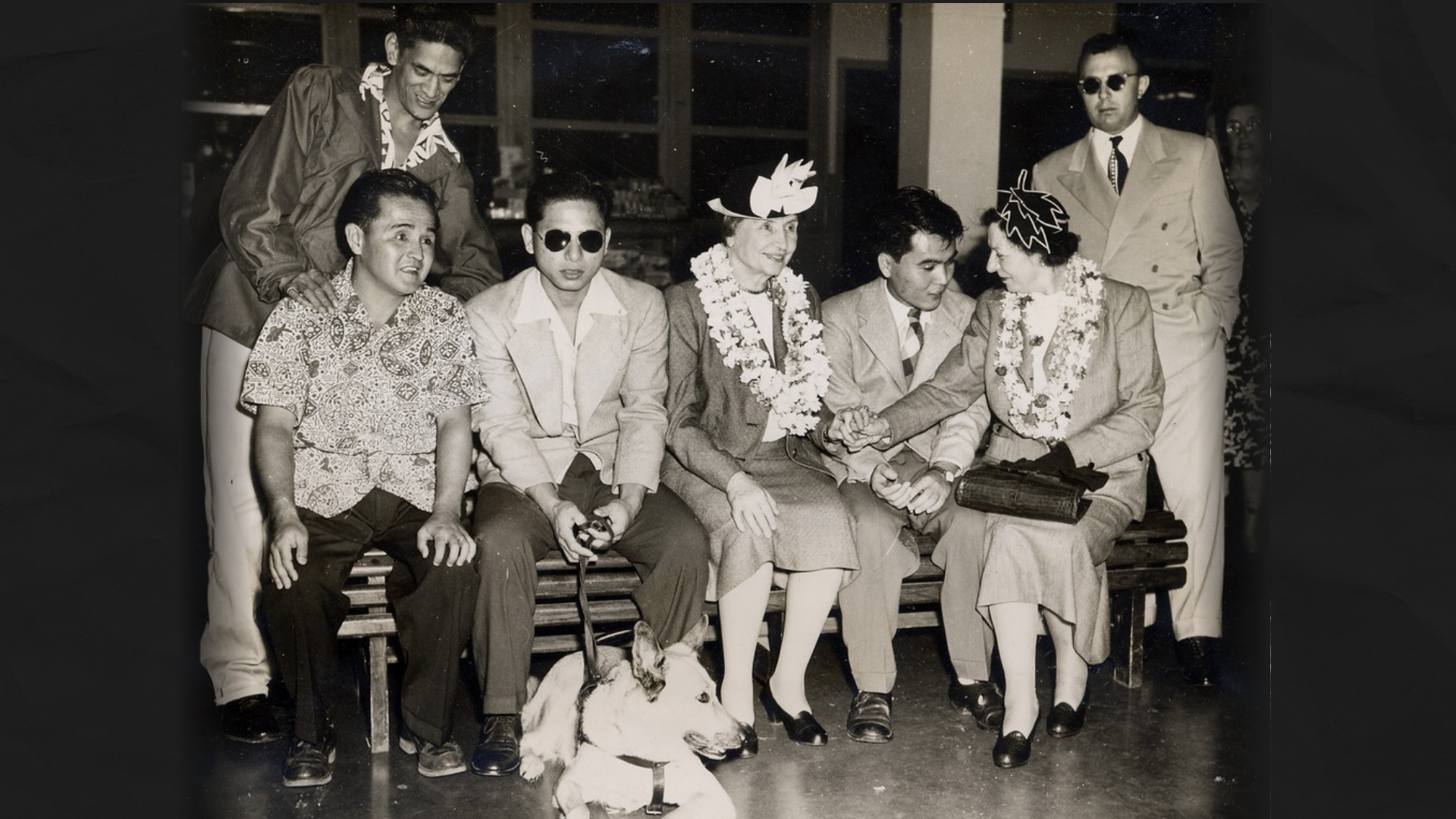
When the teacher in Tule Lake asked the children to name the school, Hannah Takagi, a Deaf teenager, proposed naming it after Helen Keller. After the students unanimously agreed, the teacher suggested that she write to Keller. Keller’s reply was printed in several camp newspapers. Despite this, the Tulean Dispatch only printed a couple of articles about school activities, and it closed down when Tule Lake was designated a segregation center.11 Other camps established similar programs, with some calling them “Helen Keller schools,” but this did not mean that the education, especially for d/Deaf students, was worthwhile, and d/Deaf students fell behind, which Holmes later related.12
![Signed note from Helen Keller: "We differ, blind and seeing, not so much in the number of senses we have as in the way we meet limitations with lifted head and smiling face. Sincerely, Helen Keller." Caption on reverse [translation]: “Helen Keller Finally Comes to Japan - Introducing the 'Talking Book' - (Tokyo) April 2, 1937.” Courtesy of the Hawai'i Times Photo Archives Foundation, Densho.](https://densho.org/wp-content/uploads/2026/02/ddr-njpa-1-764-mezzanine-a33d51c244-a.jpg)
Most students appeared to enjoy their time at these schools, but this information is largely from the perspective of the (usually White) staff.13 There is more information about the schools at Manzanar, Tule Lake, and Amache/Granada because of the reports about the programs, as well as Hannah Takagi Holmes’s testimony about her experiences at Manzanar and Tule Lake. All deaf classes were oral, although Deaf people appeared to have signed among themselves.14
Blind and visually impaired people appear not to have been included in most, if any, programs for disabled students and helped each other. They established Braille classes, with Minidoka and Heart Mountain announcing theirs in November 1944.15 Ted Tsuneo Shimano, who had worked in the carpenter shop and displayed his work at the open house in December 1942, taught braille at Minidoka.16
Were there disabled soldiers?
Yes, including men who enlisted while incarcerated. The exact number is difficult to determine. Camp newspapers frequently noted the number of men who enlisted and who were wounded or killed, but largely ignored disabled soldiers, except in a few cases. Yoshinao Omiya, Raymond Matsuda, and Kenneth Otagaki, all from Hawai’i, were covered extensively for months in most camp newspapers.

Omiya was blinded in both eyes and featured in Life magazine soon after. His Braille and Seeing-Eye dog training were covered over several articles in various camp newspapers.17 Kenneth Otakgai lost a leg and several fingers of his right hand, and he became blind in one eye and lost much of his sight in the other. He studied animal husbandry, and his adjustment to life, especially college, was detailed for about a year.18
Minidoka incarceree Hiroshi Hirai’s right arm was paralyzed. He was featured in an article when he visited his parents while on furlough. He explains that he was “Reluctant to relate his experiences because ‘it’s too hard to believe.’”19
But the most detailed, long-lasting, and widespread coverage, including on dramatized mainstream radio, was Raymond Matsuda. Matsuda was “wounded” or “crippled” (whether this was a temporary or permanent disability is unclear) and used crutches. He came to Poston to visit friends and was denied service at a nearby barber shop. Veterans, both Japanese and Caucasian, criticized the barber and wrote to support Matsuda.20

Were disabled people involved in Redress (and related activities)?

Yes. Hannah Takagi Holmes testified about her and other d/Deaf children’s experiences in camp.21 Rudy Tokiwa (Poston), a disabled veteran, convinced a White congressman, a veteran who had a similar wartime injury and disability, to change his mind and vote for redress.22 Others, such as Mabel Ota, testified about disabled family members.23 Many others, including Kenji Suematsu (Manzanar) have done oral histories with Densho and other organizations to preserve their family’s stories.24
These are a few of the many stories about disabled Japanese Americans who were incarcerated and fought during World War II. Their lives were also severely disrupted and many were disabled in camp, on the battlefield, and elsewhere. Disabled people, whether they were important historical figures or ordinary people, are important and must be included.

Footnotes:
- “Oldest Nisei, Gunner in Spanish-American War,” Manzanar Free Press (Manzanar, CA), March 27, 1943, p. 1, Library of Congress, https://www.loc.gov/resource/sn84025948/1943-03-27; “Oldest Nisei In America Also First Nisei Soldier,” Manzanar Free Press (Manzanar, CA), October 14, 1944, p. 3, Library of Congress, https://www.loc.gov/resource/sn84025948/1944-10-14/ed-1/?dl=all&sp=1.
The October 1944 article states that Sumida had grandchildren. This is likely an error and misidentification as he and his Caucasian wife Johanna Schmidt Sumida, who died before the incarceration, did not appear to have any children.
Ansel Adams, Born Free and Equal, Photographs of the Loyal Japanese-Americans at Manzanar Relocation Center, Inyo County, California (U.S. Camera, 1944), Library of Congress, https://www.loc.gov/resource/gdclccn.45002975/?sp=68.
For more information, see Nina Wallace, “Ask a Historian: What’s the Story Behind Ansel Adams’ Famous Manzanar Photos?,” Densho: Japanese American Incarceration and Japanese Internment, July 26, 2021, https://densho.org/catalyst/the-story-behind-ansel-adams-manzanar-photos/. ↩︎ - Deaf with a capital D refers to people who are culturally deaf and part of the Deaf community and primarily use American Sign Language (ASL) to communicate, while deaf refers to someone who is audiologically deaf and are largely part of the hearing community. For more information see,
“Understanding Terminology in Deaf Culture,” Deaf Services Unlimited, accessed January 14, 2026, https://deafservicesunlimited.com/understanding-terminology-in-deaf-culture/ and “Debunking Common Myths About American Sign Language and Deaf Culture,” Deaf Services Unlimited, accessed January 14, 2026, https://deafservicesunlimited.com/debunking-common-myths-about-american-sign-language-and-deaf-culture/. ↩︎ - Heidi Kim, Taken from the Paradise Isle: The Hoshida Family Story (University Press of Colorado, 2015); David Mas Masumoto, Secret Harvests: A Hidden Story of Separation and the Resilience of a Family Farm (Red Hen Press, 2023); Michael Kurima, “Japanese American Trauma During World War II Remains Too Much to Bear,” San Diego Union-Tribune, January 27, 2023, https://www.sandiegouniontribune.com/opinion/commentary/story/2023-01-27/opinion-japanese-american-trauma-during-wwii-remains-too-much-to-bear/. ↩︎
- Ronald Hirano, “Ronald M. Hirano,” interview by Lu Ann Sleeper, June 6, 2013, The Bancroft Library Oral History Center, https://digicoll.lib.berkeley.edu/record/218949?ln=en; Ronald M. Hirano, My Journey Through Four Worlds: Growing Up in the Japanese, Deaf, Hearing, and American Worlds, 1st edition (Savory Words Publishing, 2021), https://books.google.com/books?id=_auizgEACAAJ&newbks=0&hl=en&source=newbks_fb; Life Experiences of Ron Hirano-Pacific Island, directed by Marc Holmes, El Paso, TX, 2017, 1:04:17, https://www.youtube.com/watch?v=YIHJubZCCAk. For more information on d/Deaf Japanese American students at CSD, see Selena Moon, “Beyond Hannah Takagi Holmes: The Lives and Work of Deaf and Blind Japanese Americans,” Journal of American Ethnic History 43, no. 3 (2024): 57–88, https://doi.org/10.5406/19364695.43.3.01 and Ronald M. Hirano, Deaf Nikkei Wandering: Nikkei Alumni and Students of California School for the Deaf in Berkeley, First edition. (Savory Words Publishing, 2024). ↩︎
- “Fourth Case Confirmed,” Granada Pioneer (Amache, Colo.), October 20, 1943, 1, Library of Congress, https://www.loc.gov/resource/sn83025522/1943-10-20/ed-1/?; Martha Garcia, “The Legacy of Paul Yokote Still Strong Here,” Gold Country Media (Auburn, CA), July 14, 2005, https://goldcountrymedia.com/news/97295/the-legacy-of-paul-yokote-still-strong-here/. ↩︎
- Sam Mihara, “Sam Mihara,” interview by Sam Redman, November 8, 2012, Berkeley Library Digital Collections, https://digicoll.lib.berkeley.edu/record/218962?ln=en; Sam Mihara and Alexander Villarreal, Blindsided: The Life and Times of Sam Mihara, 2nd ed. (2019). ↩︎
- Commission on Wartime Relocation and Internment of Civilians, Los Angeles, CA: August 4-6, 1981, Series: Records of Public Hearings of the Commission, 1981-1981 (United States Congress, 1981), National Archives at College Park, https://catalog.archives.gov/id/241642921. ↩︎
- Richard Sakurai, “Richard Sakurai Interview,” interview by Richard Potashin, July 24, 2010, Densho Digital Archive, https://ddr.densho.org/narrators/536/. ↩︎
- Sam Mihara, “Sam Mihara,” interview by Sam Redman, November 8, 2012, Berkeley Library Digital Collections, https://digicoll.lib.berkeley.edu/record/218962?ln=en; Sam Mihara and Alexander Villarreal, Blindsided: The Life and Times of Sam Mihara, 2nd ed. (2019). ↩︎
- “Classes to Help Handicapped People,” Manzanar Free Press (Manzanar, CA), April 21, 1943, Vol III No. 32 Edition, Library of Congress, https://www.loc.gov/resource/sn84025948/1943-04-21/ed-1/?sp=3. ↩︎
- “Plans to Organize Education Program for Handicapped Made,” Tulean Dispatch Daily (Newell, CA), May 22, 1943, Vol 5. No. 54 Edition, Library of Congress, https://www.loc.gov/resource/sn87062142/1943-05-22/ed-1/. ↩︎
- Commission on Wartime Relocation and Internment of Civilians, “Testimony of Hannah Tomiko Holmes Read by Gerald Sato,” United States Congress, August 4, 1981, https://catalog.archives.gov/id/241642921?objectPage=171. ↩︎
- “Helen Keller Sends Message To Handicapped Student Here,” The Daily Tulean Dispatch (Newell, CA), August 13, 1943, Library of Congress, https://www.loc.gov/resource/sn84025954/1943-08-13/ed-1/; “Students Select Name: Helen Keller School,” The Daily Tulean Dispatch (Newll, CA), August 16, 1943, Library of Congress, https://www.loc.gov/resource/sn84025954/1943-08-16/ed-1/; “Helen Keller School Planned,” Heart Mountain Sentinel (Cody, Wyoming), December 18, 1943, Vol. II No. 51 Edition, Library of Congress, https://www.loc.gov/resource/sn84024756/1943-12-18/ed-1/?q=Helen+Keller&sp=1. ↩︎
- Commission on Wartime Relocation and Internment of Civilians, “Testimony of Hannah Tomiko Holmes Read by Gerald Sato,” United States Congress, August 4, 1981, https://catalog.archives.gov/id/241642921?objectPage=171; “Classes for the Physically Handicapped,” War Relocation Authority, n.d, The Bancroft Library;;University of California, Berkele, Online Archive of California, https://calisphere.org/item/ark:/13030/k6bk1kjz/; Final Report Community Management Division Education Section (War Relocation Authority, 1945), https://oac.cdlib.org/ark:/13030/k6cv4qtd/?brand=oac4. ↩︎
- “Shimano Conducts Braille Classes; Local Chapter Part of National Movement, Says YWCA Secretary,” The Minidoka Irrigator (Hunt, Idaho), November 4, 1944, Library of Congress, https://www.loc.gov/resource/sn84024049/1944-11-04/ed-1/?q=Braille&sp=1; “Braille Course Offered Here,” Heart Mountain Sentinel – Sentinel Supplement (Cody, Wyoming), November 28, 1944, Library of Congress, https://www.loc.gov/resource/sn84024756/1944-11-28/ed-1/.
“Braille Course Offered Here,” Heart Mountain Sentinel – Sentinel Supplement (Cody, Wyoming), November 28, 1944, 1, Library of Congress, https://www.loc.gov/resource/sn84024756/1944-11-28/ed-1/; “Course On Braille System May Be Offered Amacheans; California Boards Call 34 Nisei for Physical,” Granada Pioneer (Amache, CO), March 8, 1944, Library of Congress, https://www.loc.gov/resource/sn83025522/1944-03-08/ed-1/. ↩︎ - “Bay City Beckons Senior Carpenter Zarubi CA: 70 Workers Stage Open House As Farewell Gesture,” Minidoka Irrigator (Hunt, Idaho), December 19, 1942, Library of Congress, https://www.loc.gov/resource/sn84024049/1942-12-19/ed-1/. ↩︎
- “Blinded Nisei Soldier Writes; Messages Come From Overseas,” The Rohwer Outpost (McGehee, Ark), March 15, 1944, Library of Congress, https://www.loc.gov/resource/sn84025150/1944-03-15/ed-1/; “Morale of Blind Nisei High During Training; Radio Tells the Story of the ‘Hero and the Barber’; Sympathizers,” Heart Mountain Sentinel (Cody, Wyoming), December 16, 1944, Vol III No. 51 Edition, Library of Congress, https://www.loc.gov/resource/sn84024756/1944-12-16/ed-1/. ↩︎
- “Brothers Reunited After Ten Years; As I Was Saying,” Manzanar Free Press (Manzanar, CA), September 23, 1944, Vol. 6 No. 28 Edition, Library of Congress, https://www.loc.gov/resource/sn84025948/1944-09-23/ed-1/. ↩︎
- “War Veteran Hiroshi Hirai Tells Thrilling Experiences,” Minidoka Irrigator (Hunt, Idaho), March 17, 1945, Vol. V No. 3 Edition, Library of Congress, https://www.loc.gov/resource/sn84024049/1945-03-17/ed-1/?q=paralyzed&sp=1. ↩︎
- “Wounded Veteran of Italian Campaign Refused Service,” The Minidoka Irrigator (Hunt, Idahho), November 18, 1944, Library of Congress, https://www.loc.gov/item/sn84024049/1944-11-18/ed-1/; “Pvt. Raymond Matsuda Incident Dramatized on WMCA Station,” Manzanar Free Press (Manzanar, CA), December 16, 1944, Library of Congress, https://www.loc.gov/resource/sn84025948/1944-12-16/ed-1/; “Stand Up and Take a Bow, Mr. Hale, Sir,” The Poston Chronicle (Poston, Ariz.), November 18, 1944, Library of Congress, https://www.loc.gov/resource/sn83025333/1944-11-18/ed-1/. ↩︎
- Commission on Wartime Relocation and Internment of Civilians, Los Angeles, CA: August 4-6, 1981, Series: Records of Public Hearings of the Commission, 1981-1981 (United States Congress, 1981), National Archives at College Park, https://catalog.archives.gov/id/241642921. ↩︎
- Rudy Tokiwa, “Rudy Tokiwa,” interview by Tom Ikeda and Judy Niizawa, September 13, 1997, Densho Digital Archive, https://ddr.densho.org/narrators/92/. ↩︎
- Commission on Wartime Relocation and Internment of Civilians, Los Angeles, CA: August 4-6, 1981, Series: Records of Public Hearings of the Commission, 1981-1981 (United States Congress, 1981), National Archives at College Park, https://catalog.archives.gov/id/241642921. ↩︎
- See, for example, Nancy Ikeda Baldwin, “Nancy Ikeda Baldwin,” interview by Lu Ann Sleeper, February 27, 2013, The Bancroft Library Oral History Center, https://digicoll.lib.berkeley.edu/record/218926?ln=en; Richard Sakurai, “Richard Sakurai Interview,” interview by Richard Potashin, July 24, 2010, Densho Digital Archive, https://ddr.densho.org/narrators/536/; Kenji Suematsu, “Kenji Suematsu Interview,” interview by Sharon Yamato, April 19, 2012, Densho Digital Repository, https://ddr.densho.org/interviews/ddr-densho-1003-11-1/. ↩︎
—
Guest contribution by Selena Moon.
Selena Moon is a disabled public historian and writer based in Minnesota, and a PhD student in American Studies at the University of Minnesota Twin Cities Her research interests include multi-racial, disability, and women’s history. She researches Japanese American mixed race history, military history, and Japanese American disability history. Her research currently focuses on the disabled and mixed race Japanese Americans and their families during the World War II incarceration camps. In addition, she has editing, teaching, and cataloging experience.
This article was made possible through the support of a National Park Foundation grant.