
April 29, 2026
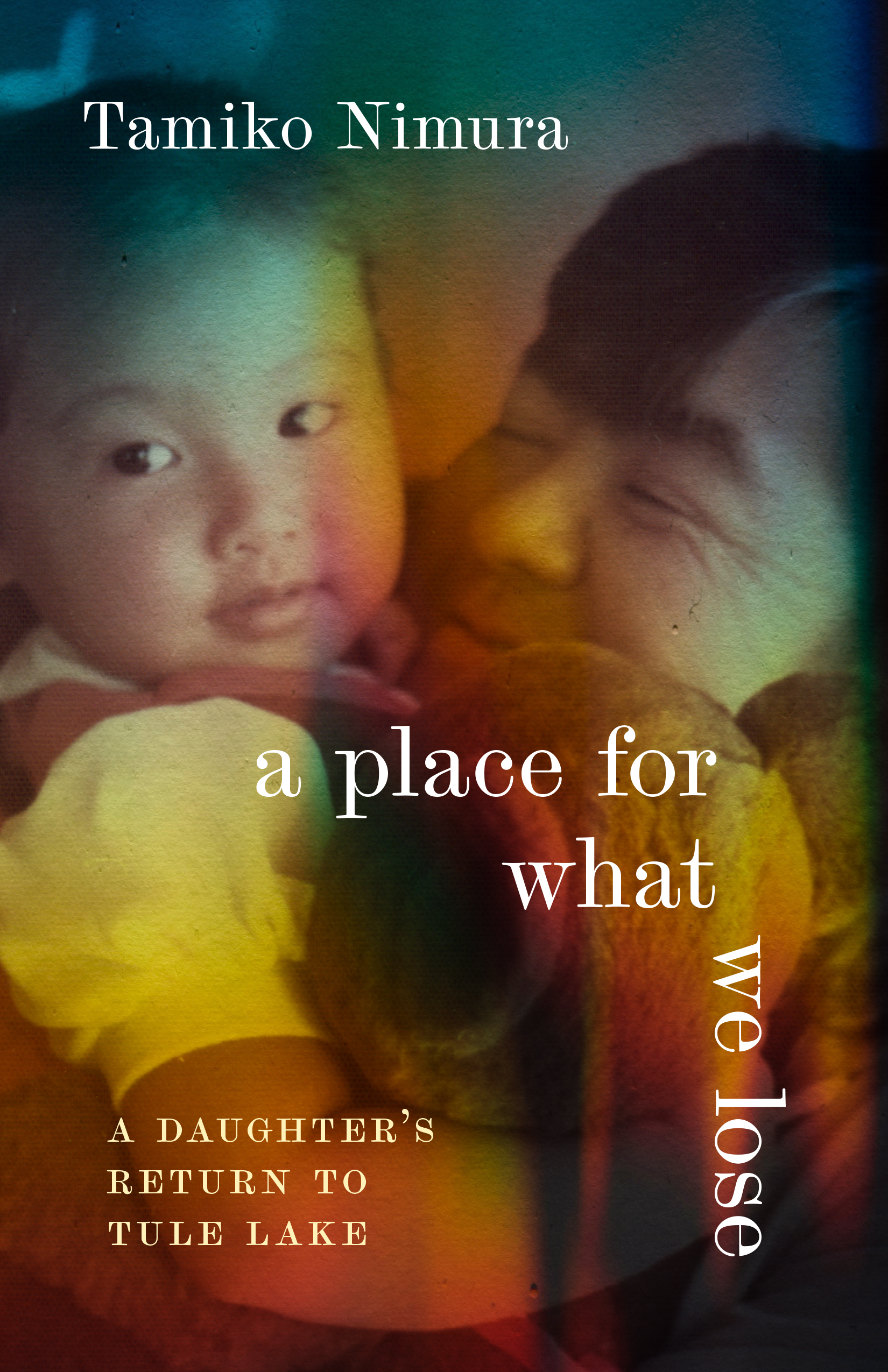
Tamiko Nimura’s new book A Place For What We Lose: A Daughter’s Return to Tule Lake braids her family history at Tule Lake with her own journey as a descendant. In an interview with Densho Sr. Development and Communications Manager Jennifer Noji, Tamiko offers insight into the book’s content, creation, and relevance today. Tamiko is co-author of We Hereby Refuse: Japanese American Resistance to Wartime Incarceration, which was a finalist for the Washington State Book Award in 2022.
Jennifer Noji: Can you briefly summarize your book and the central story or message you hope readers will take away?
Tamiko Nimura: It’s a family memoir, and it’s the story of how I learned to grieve the early loss of my Nisei father by rereading his unpublished camp manuscript and traveling on community pilgrimage to Tule Lake, where he and our family were incarcerated. I hope that readers will better understand the long intergenerational impact of wartime incarceration after reading it, and feel the power of grieving (on multiple levels) in community. That there is joy working for a community, but there is also great joy in being carried by a community.
JN: What motivated you to write this book, and what kinds of research, experiences, and activities shaped its development?
TN: I wrote the book as a way to understand a cathartic moment I had while on community pilgrimage at Tule Lake. I hadn’t expected the trip to be so emotional, but at Tule Lake I felt multiple levels of loss: a grief over losing my teaching career, a grief over losing my dad so young, when I was 10 years old, and a grief for the larger collective losses of our community.
Research-wise, there was a lot for me to unpack. I had my dad’s unpublished memoir, Daruma: The Indomitable Spirit, which he wrote sometime in the 1960s/early 1970s. That, plus my late auntie’s scrapbook (digitized by Densho) and her photo albums answered some of the questions I had. And that’s an abundance of materials, I know. But there were many questions that these materials did not answer, or that my father would not have known when he was writing his book.
I had a lot of questions about my grandfather Junichi’s FBI arrest from within Tule Lake in 1943; to the best of my knowledge, he was the first Issei to be arrested at Tule Lake, and it happened at the family barrack. And for that, I had to locate his obituary and then request copies of his WRA and DOJ files from the National Archives in Washington, DC. A public librarian helped me get my grandfather’s obituary in an out-of-print newspaper. A Japanese American friend scanned his files (some 200 pages) in a process which must have taken hours, and sent the scans to me; I can never repay her properly.
There were other questions that I had to research through interviews as well as published oral histories: what kind of person was my father, outside of my memories of him as a father? What was the family life like before World War II? They lived in a pretty rural area of Northern California, so some of my research involved looking at research on the California Japantowns site, while some of it involved asking my mother as well as my oldest Nisei auntie, Sadako Nimura Kashiwagi (and she was also interviewed by Densho).
JN: What were the most challenging, surprising, or enriching aspects of the writing process for you?
TN: Well, it took me 15 years to write this book, and while I published two other books along the way, including coauthoring We Hereby Refuse, this is the book I had been trying to write for so long. There were years that I put the manuscript away, believing that I couldn’t take it any farther or piece it together properly. The book’s themes of early parental loss, wartime incarceration, and intergenerational trauma (and resilience) made for a heavy emotional lift. And memoir is a challenging genre; with the vulnerability required for memoir, it can rewrite you as much as you rewrite it. As Junot Díaz said of his book The Brief Wondrous Life of Oscar Wao, I had to become the writer the book needed me to be: more experienced, more vulnerable, more playful, more rooted in community.
The structure of the book was also a huge challenge. There are essentially two main characters (my father and me), multiple timelines, and three main stories (the early loss of my dad, his family’s wartime incarceration, my grandfather’s arrest from within Tule Lake). Complicating all of that was my desire to braid all of it together rather than tell it in a linear fashion. As my writer friend Ann Putnam once explained to me, “all loss evokes other loss,” and I wanted a structure that reflected that layering. I tried many different structures before landing on this one, and even in the year before publication, I must have restructured the manuscript several times. I’m writing about this process for a different publication, but in a nutshell: I was talking to a dear editor/writer friend, Lisa Factora-Borchers, who asked me, “How does the book want to be structured?” I knew right away: It wanted to be a library. And then so much fell into place.
There were so many welcome surprises, though, especially with the writing and archival research, and the gifts of reflection that memoir can give.
JN: How does your work expand, complicate, or challenge existing narratives and scholarship about Japanese American incarceration?
TN: I am honored to be a Nikkei writer in the footsteps of Yoshiko Uchida, Janice Mirikitani, Hisaye Yamamoto, Miné Okubo, Toshio Mori, John Okada, and my uncle Hiroshi Kashiwagi all the way through Satsuki Ina, Brandon Shimoda, and Karen Tei Yamashita. I have read and studied the work of these authors for many years now, some even for decades. And in some ways the memoir builds on the work we began in We Hereby Refuse: telling lesser-known stories of resistance to incarceration. My grandfather Junichi Nimura’s story that I outline in this memoir is not like one that I’ve read anywhere else.
But the emotional reckoning and vulnerability in this book feels new to me. It was tough not only to feel the layers of loss at Tule Lake, but to write about them publicly in a way that readers will hopefully feel them as well.
I really tried to make this book a conversation with my father’s book, rather than a straightforward reproduction of his words. I respond to passages in his book, but I also contradict and question other passages. That also feels new.
I am also interested in conversations about the long aftermath of incarceration: ones that yield complex meanings of resilience, hoarding, and bitterness. As Vince Schleitwiler says, the incarceration is an unfinished history because many are still struggling to determine its meaning (including survivors and descendants)—and as Brandon Shimoda says, the incarceration has never really ended; it’s just in its next phase.
JN: Who do you see as the primary audience for this book, and what do you hope readers will learn, question, or carry forward after engaging with it?
TN: I see my audience as an onion, with many layers of potential readership. At the core of the onion is of course the Nikkei community, particularly descendants like me who have inherited the history of Japanese American wartime incarceration. I hope that many Nikkei descendants will think about the histories, the family lore, the archives—or the lack of these things—and take these things up like prisms, seeing how they might feel reflected or refracted when turned toward different lights.
More broadly, I am thinking about Asian Pacific Americans, BIPOC readers, students in American ethnic studies who have inherited some form of difficult history in their own families but are unsure about how to go about processing that history. I hope that this book provides one example of how that might happen on multiple levels.
And I hope to add to the conversations about the impact of incarceration on children, as we are experiencing a terrible new era of family detention and deportation.
JN: What other hopes do you have for the book’s impact?
TN: I hope that people can experience the power of community pilgrimage and do more to support community efforts to preserve these histories. I hope that the book can become a tool in historic preservation efforts at Tule Lake and the other incarceration camp sites. Still more broadly, I am thinking about readers who are interested in memory work, archives, genealogy, monument work, and historic preservation.
JN: What projects or next steps are you currently working on?
TN: Right now I’m preparing for a series of book tour events through 2027 that will hopefully yield a good shelf life for A Place For What We Lose. I’m also part of the planning committee for the Tule Lake pilgrimage this summer. It will be incredible to bring the book back to one of its points of origin.
But I have at least two major writing projects waiting on the back burner. The first is a book about Japanese Americans and archives, along the lines of Karen Tei Yamashita’s forthcoming book Question 27 Question 28 and Christina Sharpe’s book Ordinary Notes. The second is a love story; I’ve never really tried fiction before this project, and it’s nice to think about something lighter after the memoir. (And there are a few children’s books I would love to write!)
JN: Is there anything else you would like to share?
TN: Densho’s work to digitize my family archives, preserve oral histories, and answer my questions has been invaluable. I would not have been able to complete my book without you.
Although I’m a little sheepish that the book has taken so long (15 years) to write and to be published, the village that the book has built for itself along the way has been one of the most wonderful gifts. One of the hardest parts of grief is the seeming isolation that many folks experience. Writing and publishing this book has taught me that community can carry us through.
—
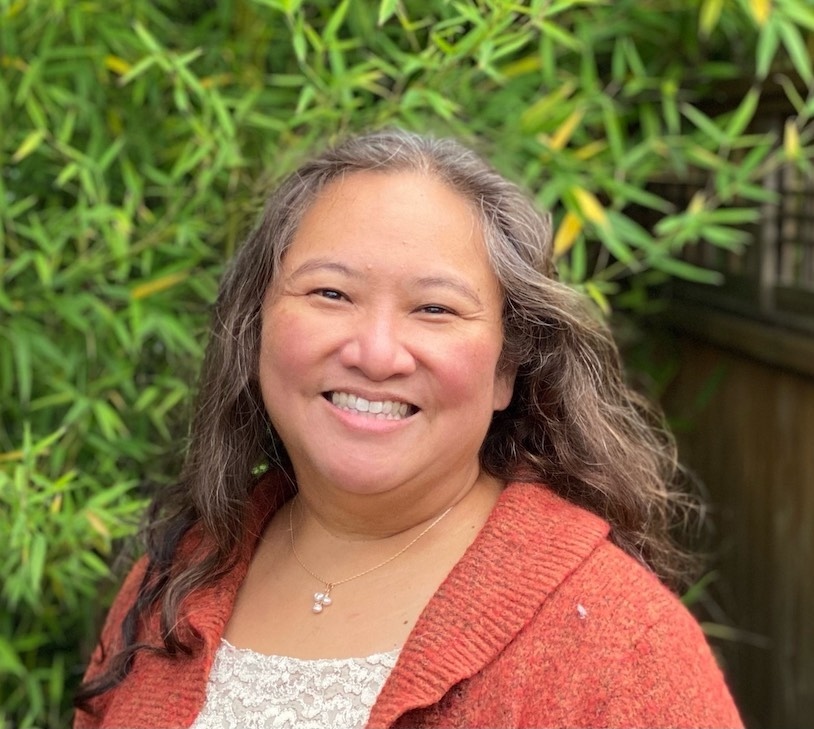
Tamiko Nimura, Ph.D., is an award-winning Asian American (Sansei/Pinay) creative nonfiction writer, community journalist, and public historian. She writes from an interdisciplinary space at the intersection of her love of literature, grounding in American ethnic studies, inherited wisdom from teachers and activists, and storytelling through history. Her work has appeared in a variety of national and international outlets, including San Francisco Chronicle, Smithsonian Magazine, Off Assignment, Narratively, The Rumpus, SFMOMA Open Space, and Seattle’s International Examiner. A two-time VONA Voices fellow, she has received awards from the Ford Foundation, Artist Trust, City of Tacoma Artists Initiative, the Tacoma Arts Commission, and the Tacoma Historical Society. Her commissioned work includes a California permanent exhibit, a co-authored graphic novel titled We Hereby Refuse, and a 10+-year series of essays for the Japanese American National Museum. She is a board member of the Tule Lake Committee. Her forthcoming memoir is titled A PLACE FOR WHAT WE LOSE: A DAUGHTER’S RETURN TO TULE LAKE (University of Washington Press). As the direct descendant of Japanese American World War II incarcerees, Tamiko has worked to keep this history alive through her writing and public speaking.
Join Tamiko Nimura at the Seattle Public Library on Tuesday, May 5, 2026, 7–8:15pm PT for a conversation about her new memoir. Tamiko will appear in conversation with Densho Archives Director Caitlin Oiye Coon and Shawn Wong. Click here to learn more about the program.