March 11, 2026
In this two-part series, Densho’s Education and Public Programs Manager, Courtney Wai, reflects on how her experiences as a classroom teacher working with immigrant students shaped her understanding of immigration enforcement, state power, and the role educators play in protecting young people. Here, in Part I, Courtney shares personal experiences and reflections drawing from her time teaching in Texas and from the history of Japanese American incarceration. In Part II, she explores what it means to ensure schools remain places of refuge rather than fear, and what history asks of educators in this moment.
My Personal Experiences Teaching Immigrant Students
My experience as a teacher—particularly a teacher of young immigrant students—has indelibly shaped not only my career, but how I move through the world. When I began teaching in the Rio Grande Valley, Texas, I ended up living in a hyper-militarized border zone, a place where civil rights are suspended, where Border Patrol or state trooper’s SUVs appear every few blocks, and where my own car was once stopped and searched for driving “too close to the border.”
The first school I taught at was less than a mile from the U.S.–Mexico border. Our janitor told me that he sometimes found migrants sleeping beneath the classroom trailers in the mornings, seeking shade from the brutal Texas heat. Lockdowns were frequent. I remember flinching once when our administrator asked for all students and teachers to remain in their classrooms, explaining over the intercom, “There’s an illegal alien here.” I remember looking at my students and wondering what message this sent. Why was the “danger” framed as someone undocumented? Why not simply say there was a stranger on campus? What were students meant to absorb about who was considered a threat?
I taught undocumented students, students in mixed-status families, students who crossed the border daily, weekly, or monthly to attend school, and students who had U.S. citizenship. I taught students permanently separated from their parents, living instead with relatives because reunification in the U.S. was impossible and returning to Mexico was not an option. For these students, parent-teacher conferences happened over email or Skype. And yet, what stood out to me, just as powerfully as the instability they navigated, was how deeply they and their families cared about education. Parents rearranged work schedules, crossed borders when possible, logged on from miles away, and trusted schools with enormous hope. My students spoke about college, about careers, about wanting to support their families. They showed up, often across literal and metaphorical borders, because they believed education mattered.
Even outside the classroom, the presence of the border shaped daily life. In the evenings, I played in local soccer leagues, but games were sometimes canceled when crossings closed or checkpoints appeared, and people were afraid to drive. What should have been a routine community activity was disrupted by the same surveillance that followed my students into school.
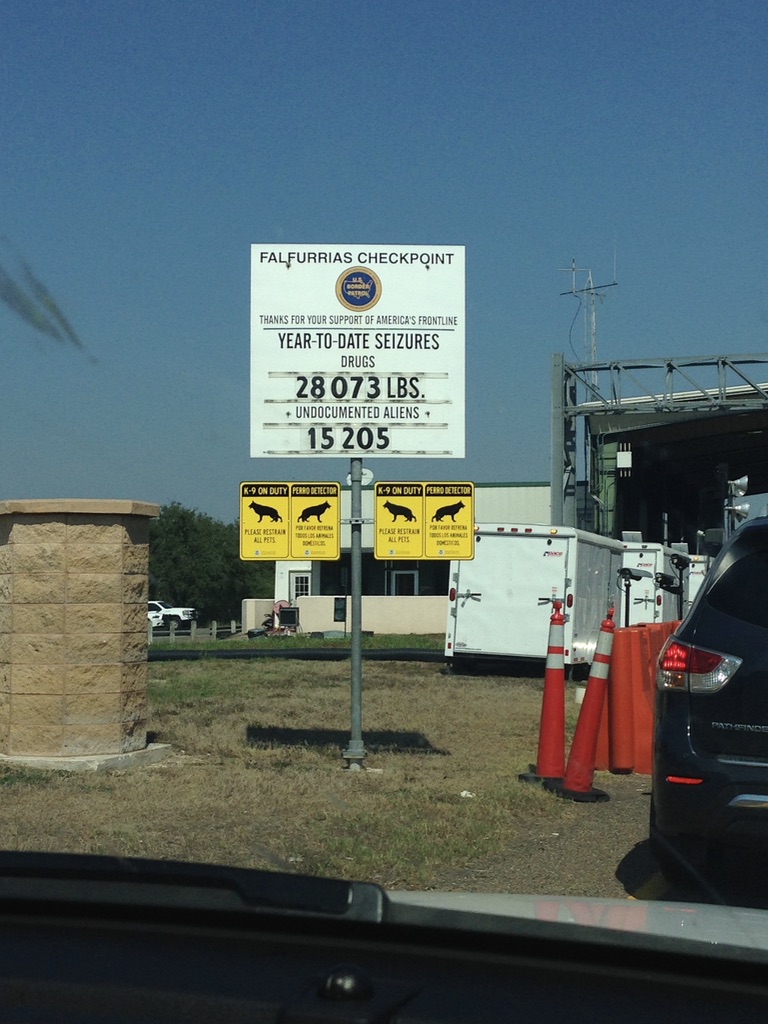
When I took my students on their first overnight trip to visit colleges in Texas, we had to pass through the Falfurrias checkpoint—the only way out of the Rio Grande Valley by car. By then, I knew it as the place where some of my students’ family members had been apprehended.
Border Patrol agents with large guns holstered at their hips would ask, “Are you a U.S. citizen?” Dogs would surround and sniff the vehicle. Cars would pass through what looked like a giant garage to be weighed and X-rayed. The checkpoint was designed to intimidate. It sits within a broader enforcement strategy, which some have referred to as “Prevention Through Deterrence,” in which the federal government weaponizes the Valley’s harsh landscape, making crossing more dangerous in the name of border control.
There was no checkpoint entering the Valley, only one leaving it, which raised similar questions: what does it mean when movement out is surveilled, but movement in is not? What does that suggest about who is seen as dangerous, and who is being protected from whom?
I now live in San Antonio, Texas, but the last time I taught, I was an English as a Second Language teacher; every student in my classroom had recently arrived in the country. They came with hopes and dreams and an extraordinary commitment to learning. Every student and their family valued education deeply, often seeing it as both opportunity and responsibility. All while supporting one another through the daily work of building lives in their new country. And yet, even outside the 100-mile border zone, questions about safety, security, and immigration lingered in the background. I watched my students’ body language shift whenever the door next to my classroom stood open. That room belonged to the San Antonio Police Department, a space where officers stored their bikes before patrolling the campus and neighborhood. I found myself wondering again: Were they meant to protect us, or to intimidate us? Whose safety was being prioritized? Whose fear was considered acceptable?
Those questions have only spiked with time and the escalation of immigration enforcement. This month, I learned that ICE purchased a space to create a detention center across from a school serving primarily students of color, and twenty minutes from where I live, in addition to a second facility across from a public university (where I received my Masters) and near a hospital. Once again, I am left asking: What messages are young people being forced to absorb about surveillance and belonging? Whose presence is considered a problem to be contained?
Moments of immigration enforcement, detention, or policy shifts never stay “outside” of schools. Long before anyone names them aloud, these forces shape how students experience school; I saw how some of my students withdrew, became silent, or were absent. Over time, this erosion of safety sends a clear message about whether school is meant to be a place of refuge or of risk.
That fear is not limited to students who are themselves immigrants. Students in mixed-status families often carry constant worry about parents, siblings, or other loved ones. For many, this fear is compounded by distrust of institutions, the challenge of learning a new language, and the responsibility of serving as a family translator. Research confirms what educators see every day: immigration enforcement and the threat of detention shape students’ emotional well-being, attendance, and engagement.
So what does that mean for educators? Sonia Nieto, in her essay “Nice Is Not Enough,” reminds us that caring for students of color requires far more than good intentions. She writes, “Even as we purport to care about all students equally, we also often tolerate policies in our districts and schools that harm students of color, especially those who are poor and those for whom English is a second language.” In this context, neutrality is not benign. For our students and their communities, being a bystander is not an option. Educators are called to respond not simply as caring adults, but as protectors.
If educators are called to respond as protectors rather than bystanders, we also need historical clarity about how state power has been used to justify harm in the name of “security.” For me, that clarity comes, in part, from the history of Japanese American incarceration during World War II, and the immigration laws and beliefs that made it possible.
Immigration and Japanese American Incarceration
The Alien Enemies Act laid critical groundwork for the surveillance, detention, and removal of people based not on individual wrongdoing, but on nationality. Although the law predated World War II, it was mobilized to legitimize sweeping civil rights violations against Japanese and Japanese-descendant communities. Under the guise of national security, the government normalized the idea that Japanese Americans could be treated as inherently suspicious and subject to monitoring, detention, and removal simply because of who they were perceived to be. They were also stripped of their freedom without charges, trials, or evidence of disloyalty.
Former incarcerees have repeatedly warned us about the danger of this moment. They remind us that these policies were not accidents, nor were they inevitable. They were choices made possible by laws that allowed fear to override civil liberties, and by a public willing to accept the punishment of entire communities in the name of national protection.
The geography of the incarceration was not incidental to this harm. Japanese American confinement sites were deliberately placed in remote, inhospitable locations, cutting people off from resources and the eyes of the public. This strategy echoes contemporary border enforcement approaches such as “Prevention Through Deterrence,” which rely on the brutality of border crossing regions while allowing the government to deny culpability by weaponizing the landscape. (It’s worth noting that this carceral logic is not unique to wartime incarceration. As Angela Davis argues in Are Prisons Obsolete?, the remote placement of U.S. prisons similarly functions as a tool of control, separation, and social disappearance.)Today, detention has become a normalized response to migration. Families are separated under the guise of security. Immigrants are framed as threats rather than as neighbors, colleagues, and classmates. Immigration policy continues to function as a system of racialized punishment, relying on legal structures that target whole populations rather than individual actions. Just as in the past, the guise of national security is used to legitimize harm against immigrants and to distance the public from its human consequences.
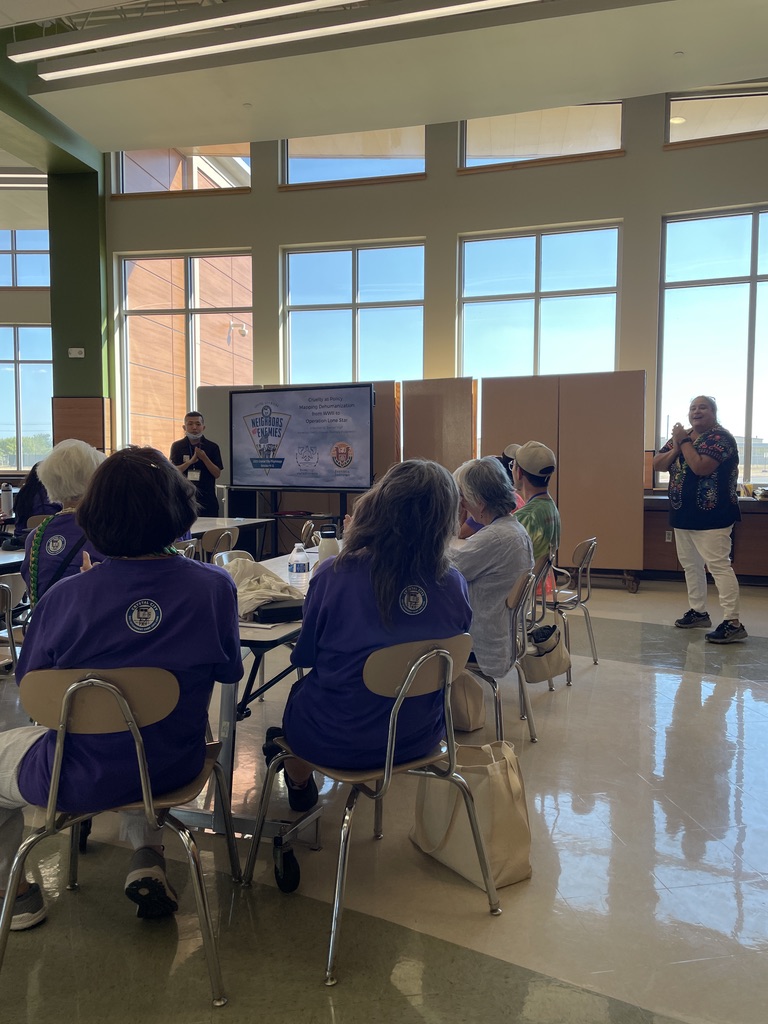
At the same time, these histories are not only about harm and confinement; they are also histories of resistance. During World War II, Japanese Americans resisted incarceration in multiple ways—by challenging the government through legal cases, organizing labor strikes and protests within camps, preserving culture and community under impossible conditions, and later demanding redress and public accountability. Resistance did not always look the same, nor was it without risk, but it reflected a refusal to accept dehumanization as inevitable. Similarly, immigrant communities today continue to resist systems of detention and deportation through protesting, legal advocacy, mutual aid, storytelling, and youth-led action.
Understanding Japanese American incarceration not as an isolated historical event, but as part of a longer continuum of immigration enforcement and racialized state violence, challenges us as educators to ask harder questions in the present. How quickly can rights be stripped away? Whose humanity is expendable, and whose is worthy of protection? What responsibility do educators have when history begins to repeat itself?
—
By Courtney Wai, Densho’s Education and Public Programs Manager.
This post is the first in a two-part series on how Japanese American wartime incarceration history offers important lessons on protecting immigrant students. In the next piece, Courtney discusses resources and strategies for educators.