July 10, 2026
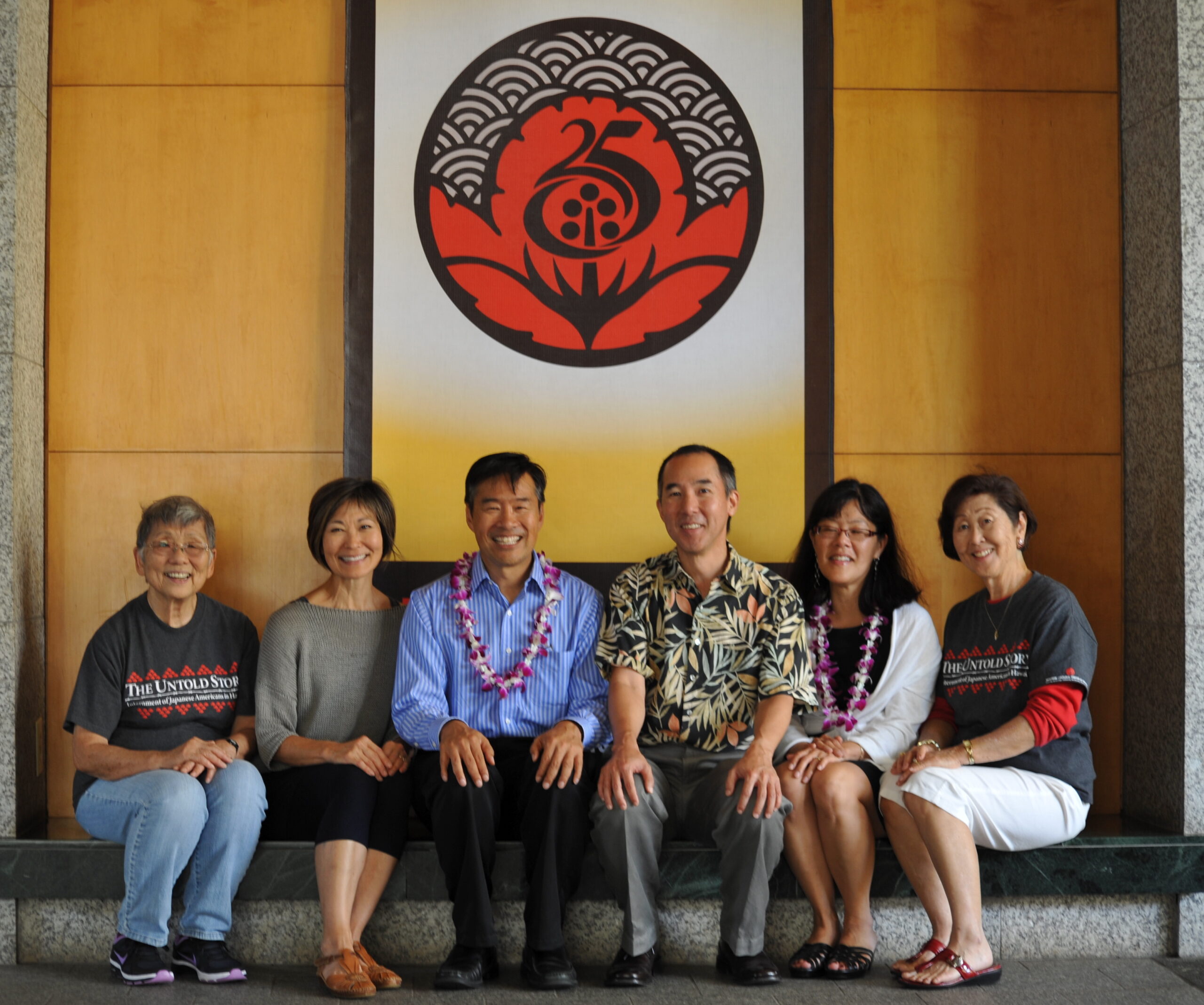
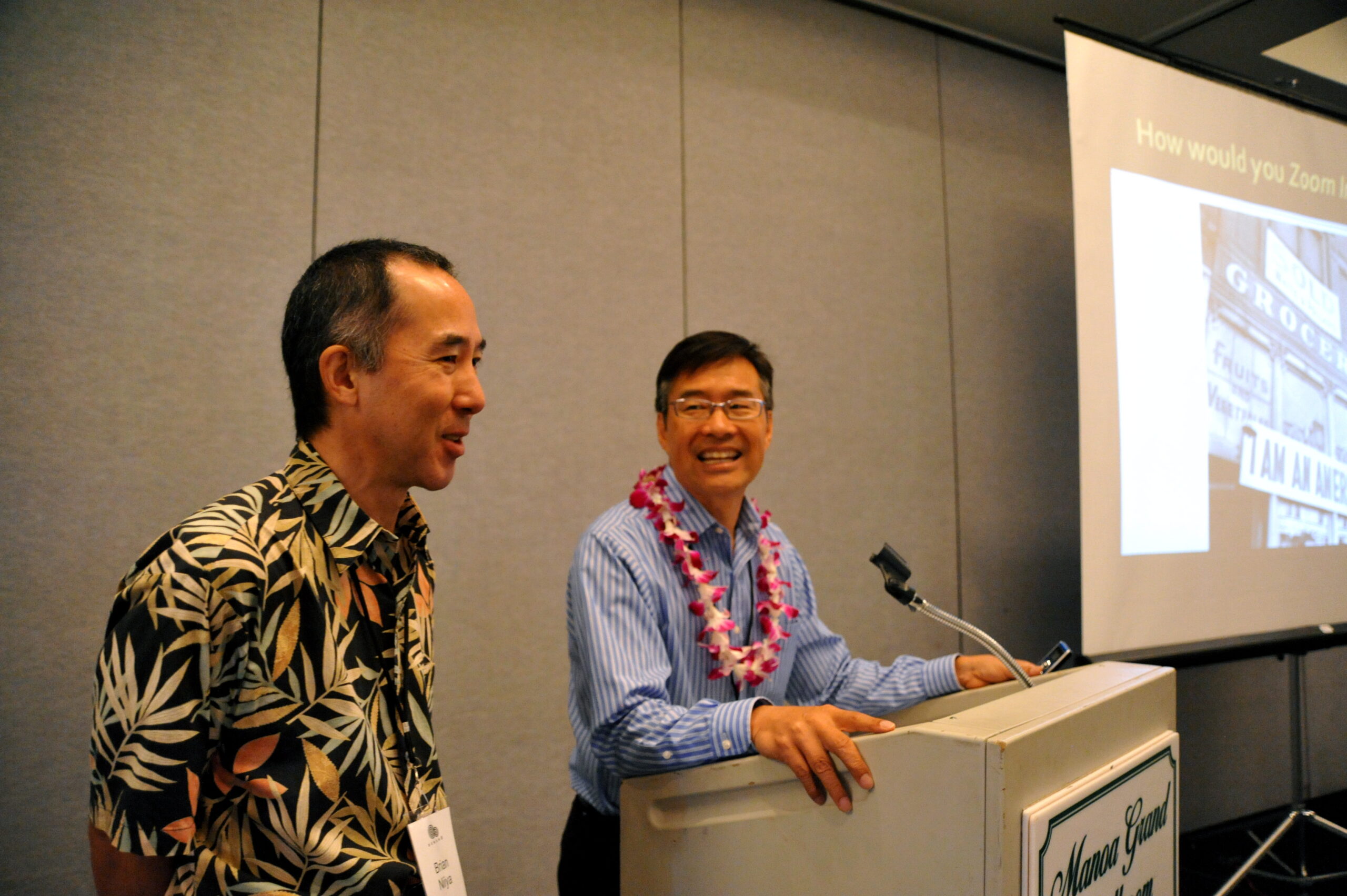
This fall, one of Densho’s longest serving staff members, and one of the most trusted voices and sources of Japanese American history, will be retiring from his position as Content Director. Brian Niiya, who has been with Densho since 2010, has garnered community-wide esteem and trustworthiness for his historical expertise and contributions to Densho’s Encyclopedia — a resource that he created and that countless people rely on. Having authored approximately 375 encyclopedia articles, Brian’s writing on Japanese American history have largely shaped public understanding of the WWII incarceration and Japanese American history more broadly. As he leaves Densho to pursue retired life, he assures us that he will remain deeply involved and active in the community. As Brian says: “You won’t have to look around too much to find me.”
This conversation is part of our new “We Are Densho” series, which highlights the people—our staff, board members, supporters, partners, and community members—who have made Densho what it is today.
Diana Tsuchida: Could you start with how you were called into community history preservation? What initiated your interest?
Brian Niiya: There are two different moments that come to mind. One was in college. I went to Harvey Mudd College, and Harvey Mudd is this little school that has only STEM majors. So I was an engineering major. Like most 17, 18-year-olds, I had no idea what I wanted to do. I was an Asian kid who was good at math. So engineering, that’s a logical thing. In retrospect, I’m probably the least suited person possible to be an engineer because I have absolutely no mechanical ability, and any knowledge I have is purely theoretical.
But the saving grace of going to the Claremont Colleges is that you can take classes at all the other colleges, so I was able to take anthropology classes and philosophy and all of these classes at other schools. And at the time, there was one Asian American class. It was taught by a psychologist named Rick Tsujimoto at Pitzer. So I took it and it was like the cartoon character where the light bulb goes on and the clouds part. It was like, wow. It just felt like something I knew I really wanted to do. Much to my parents’ disappointment, when I graduated with my engineering degree, I didn’t work a day as an engineer. Eventually, I was able to get into graduate school in Asian American Studies at UCLA, despite having an engineering degree and having taken one Asian American Studies course. There’s no way I’d get into that program today, but back then, yeah. So that was one moment.
I think the second one is when I finished the Asian American Studies master’s in 1987. That was right at the moment when the Japanese American National Museum was hiring people. They hadn’t opened to the public yet, but they were starting to put together their collections and their exhibits and so on. I just kind of stepped right into that and it was just the luck of timing. At UCLA, my research had been more in the literature area. It wasn’t specifically Japanese American and it was really the work at JANM that pushed me into that Japanese American history direction. So I think those two moments are the ones that set me on that path.
Diana: What was it about the class and what were you reading and learning that influenced you so deeply?
Brian: I don’t know if it was anything in particular. It was just learning this history. Which, I’d heard bits and pieces of, but it’s like, really, this happened? Camp, really? So just that sense of discovery, which I teach now, too, and I see that in my students now. And part of the class [was] we had to go out and do some fieldwork. I ended up in Little Tokyo, and this is the middle of the Redress Movement, which I knew nothing about. So I remember interviewing Evelyn Yoshimura, who’s very active in the community, part of NCRR, was one of the founders of Little Tokyo Service Center. We got to be good friends later but someone told me I needed to interview her, and I just remember meeting her and interviewing her. Being encouraged to go out and talk to people and getting introduced to the Redress Movement in Little Tokyo and the Japanese American community was a part of that.
Diana: When did the opportunity at Densho come along? How did you get connected to Tom?
Brian: I worked for JANM on and off for about a decade but then in 1996, I moved to Hawai’i. My wife got a position at the University of Hawai’i, so we moved. I’m born and raised in LA, but my parents are both from Hawai’i, so I had this familial connection there. I was there for 20-something years. Somewhere along the line I had met Tom at conferences and knew him a little bit. And I was working for the Japanese Cultural Center of Hawai’i in the 2000s.
Then what happened was, Densho got the JACS grant to do this online encyclopedia. And Tom basically called me and said hey, do you want to come work for us and work on this? What he told me later though is that it was Roger Daniels who was the one who had suggested this. Tom said that when he was talking to Roger about the encyclopedia project, Roger said, “Why don’t you call Brian?” Because I had done the print encyclopedia for JANM back in the ’90s. So in this indirect way, I kind of owe Roger Daniels for being connected to Densho.
Diana: Did your family’s history influence the way you approach the work, and did it drive you in certain ways to pursue this career?
Brian: Yeah, unquestionably. One of the standard stories that Sansei tell is that their parents didn’t talk about camp, or if they talked about it, they only talked about dances and happy stuff. And then they learned the other stuff later through college or [from] what was going on in the community in the ’60s and ’70s. But my mom was not one of those. She would tell me the family history from very early on. And I remember sometime when I was a kid, 8 or 9, I played an April Fool’s joke on her. My mom had a great sense of humor, but she was very serious at that moment and said, “We don’t do April Fool’s in this house.” And she told me why.
My grandfather was the managing editor of the Nippu Jiji newspaper, one of the two major Honolulu newspapers before the war. He was arrested on the night of December 7th. My mom remembers two large FBI agents coming and arresting grandpa and taking him off. And eventually he’s interned at Sand Island, sent to camps on the continent like most of the Issei in Hawai’i. My mom’s family actually goes to the continent to join them, ends up at Crystal City, and from there they’re one of the families that go on the Gripsholm, the exchange ship. Evelyn Iritani just wrote on the Gripsholm Exchanges. She interviewed my mom because they were one of the families that were involved in that exchange.
They ended up in Singapore and then eventually, when they went from Singapore to Japan, the women and the men went on different ships. The women’s ship made it, but the men’s ship was the ill-fated Awa Maru, which was sunk on April 1st. The youngest son who was 10 at the time, [and my grandfather] both perished at that time. That always stuck with me.
So I think even subconsciously, that drove me into the field. I feel like I’m almost carrying on what my grandfather did. What I’m doing is similar to what he was doing, in a lot of ways. The thing that just gets me today is that I’m 20 years older than he was when he died. He was in his 40s when he passed away, and that part just seems so strange.
And my mom, because of her circumstances, she never graduated high school because she had her education interrupted by the war. They were among the Nisei caught in Japan during the war [and who] couldn’t get back. So she ends up going to middle school in Japan, comes back to Hawaii as a 17-year-old, but she hasn’t finished high school. She takes a GED equivalent, but she never formally graduates high school.
But she has this total intellectual bent. I’m convinced she would have been a professor of East Asian languages or something under different circumstances. So I think I got that impulse from her, even though she has no academic training. She was always reading. She was fluent in Japanese and English, could read Japanese well. So, I think that was a strong influence.
Diana: You’ve continued a lineage of producing knowledge. That’s an incredible and very tragic family history. Thank you for sharing that. Is there any special process that you’ve developed for your preparation and research? Is there a method to how you develop your pieces of writing?
Brian: I have no formal training for better or for worse. So, what I do is probably not recommended, but just over the years through working at JANM, UCLA Asian American Studies Center, JCCH, and Densho, basically just reading everything that’s come out, I’ve gotten into the habit of making notes of everything. All the books and articles and all the primary materials. I think I’ve been around long enough that any topic that comes up, I already know something about.
I think the thing that’s happened in recent years is just so much material has come online. Densho, of course, but Berkeley’s digitized all the WRA records, NARA’s digitized assembly center material, and all the Form 26 database, and there’s just so much material. So it’s just knowing where those caches of information are and starting. I’ve just got all this material on my hard drive and it’s just, okay, subject X, let me do a quick search on the material I have first. Because I’ve been around a while, and I’ve been in this field for a long time, I already know what all the secondary sources are. Let’s scan through what the primary sources are and then from there, knowing that maybe I should look at these newspapers or maybe I should look at the WRA records from Topaz or whatever, and then from there being able to zero in on the particular sources I need.
Diana: Reflecting on your time, are there particular collaborations and projects you worked on that really stand out as impactful for you?
Brian: Too many. The resource guide. I particularly enjoyed writing the “Ask a Historian” articles for the blog and also the “Nisei Notables.” I think if I were to continue, those are things I’d love to continue — because as much as we know about the incarceration, there’s still so much we don’t know. And a lot of the “Ask a Historian” pieces are very basic things like which camps had fences, how were pets handled, how did they feed babies, and those kinds of very simple things, which end up having sometimes really complicated and interesting answers. So those are a lot of fun, and I think I’m uniquely suited to write those, just because I know something about every camp and can talk about the differences and uniquenesses about how it was handled in different places.
The Scholars Roundtable was another project I worked on through the Encyclopedia [and enjoyed]. I knew a lot of the scholars in the field before, but getting to know some really well and becoming really close friends with a number of them through the work here [at Densho] has been really, really gratifying.
Miya Schilz: What does Densho’s longevity say about the importance of preserving and sharing Japanese American history?
Brian: Yeah, it’s funny, I left LA and went to move to Hawaii right about the time Densho started in the mid-’90s. And at that point in time, this was a period when those who had been incarcerated in camp were old enough to have adult, or at least teenage, memories of camp. That generation was starting to pass on, and so I think at that time, there was a real question about what things would look like in the future when that generation was passing on. Would there still be interest in the subject? The core part of Redress was over. So, what was going to happen in the future? That was right when Densho was starting.
And 20 years later, it’s clear that this story is going to vastly outlive those who were in camp. There’s greater interest now in this story than there ever has been, I think, largely for negative reasons, I would say. But I wrote this in a piece on pilgrimages, where I wondered if they would survive. Flash forward to today, they’re huge now. They sell out. I mean, who imagined that? So I just think the future of Densho is bright.
Miya: What are your hopes for Densho’s future?
Brian: I think we’re very optimistic that Densho will carry on and move forward and continue to do the work that it’s doing. I think its strength is that Densho is kind of neutral ground, or it’s an organization that everybody kind of likes and needs, and I feel like that’s a role we can continue to play.
Miya: What are you most looking forward to in retirement?
Brian: My wife once asked me what an ideal day in retirement might look like. After I told her, she paused for a moment, and then said, “Isn’t that kind of what you do now?” So I think I do look forward to being able to continue to do research and writing, the parts of the job I really enjoy, without having to worry so much about administration, grant related issues, and the like. There are literally a dozen or more research projects I’m interested in, so I need to prioritize.
I’m also thinking about whether—or how much—I want to teach and am thinking about doing a community version of the Japanese American incarceration class I teach at UCLA. I’ll also continue to be involved with “camp world,” attending pilgrimages, Day of Remembrances, and myriad events—and maybe even organizing a few—that occur in a place like Los Angeles, as well as continuing to engage with scholars in the field. And of course I’ll do some more typical retirement pursuits—travel, time with family and friends, etc. So you won’t have to look around too much to find me!
—
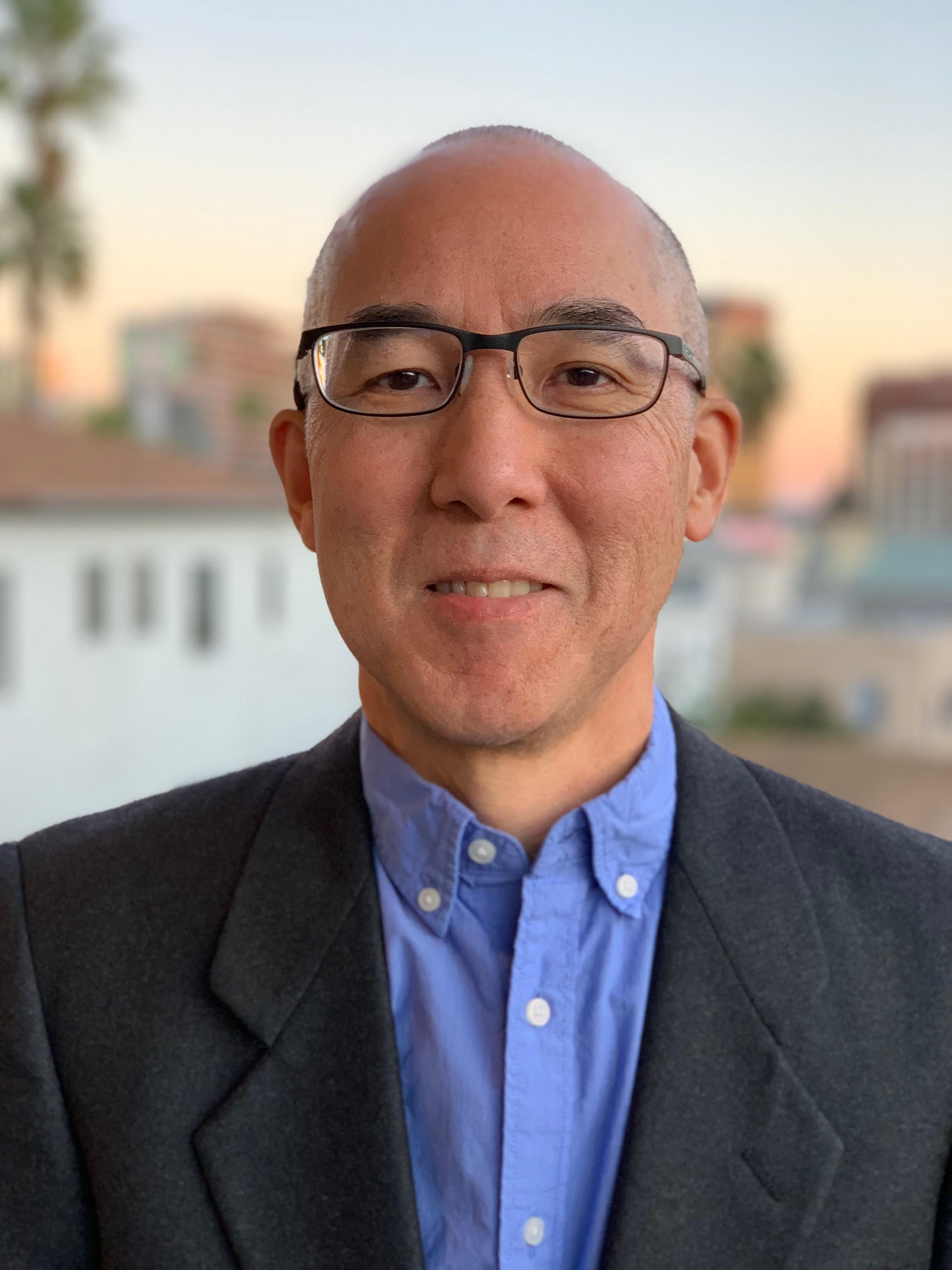
Interview with Brian Niiya, Densho Content Director, conducted by Diana Tsuchida, Densho’s Communications Manager, and Miya Shilz, Densho’s Digital Content Coordinator.