March 23, 2026
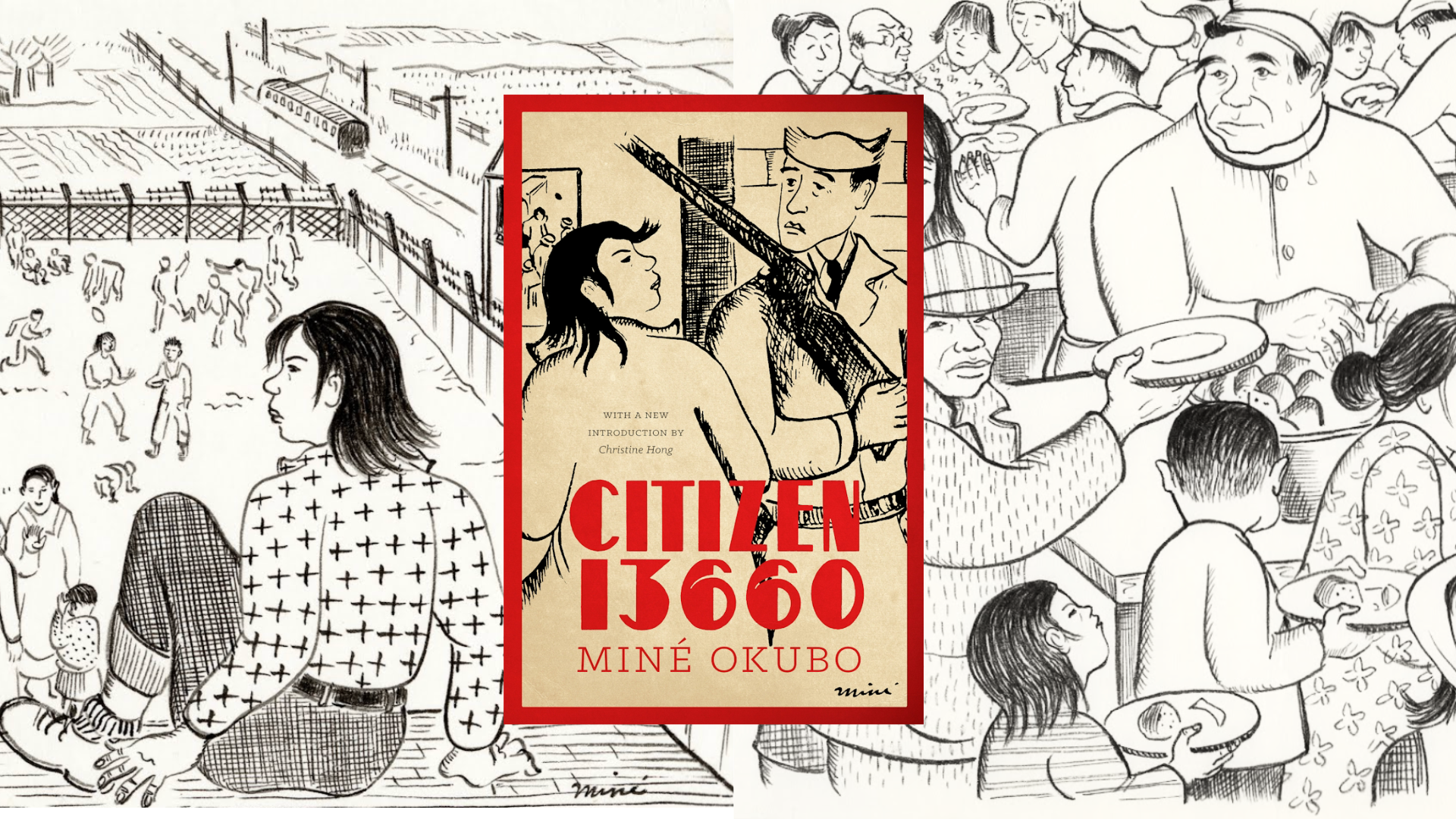
Decades before the modern graphic novel emerged as a popular genre, Miné Okubo’s Citizen 13660 used visual storytelling to document the trauma of WWII Japanese American incarceration. In this guest post, Haeley Christensen, a PhD student in English and Comparative Literature at UNC-Chapel Hill, analyzes Okubo’s 1946 book, exploring its significance both when it was published and today. Haeley argues that by contrasting her detailed portraits with the era’s dehumanizing propaganda, Okubo’s work performs a vital subversion of the “faceless” enemy. Okubo’s sketches remain a testament to how art can bridge the gap between hidden suffering and public memory.
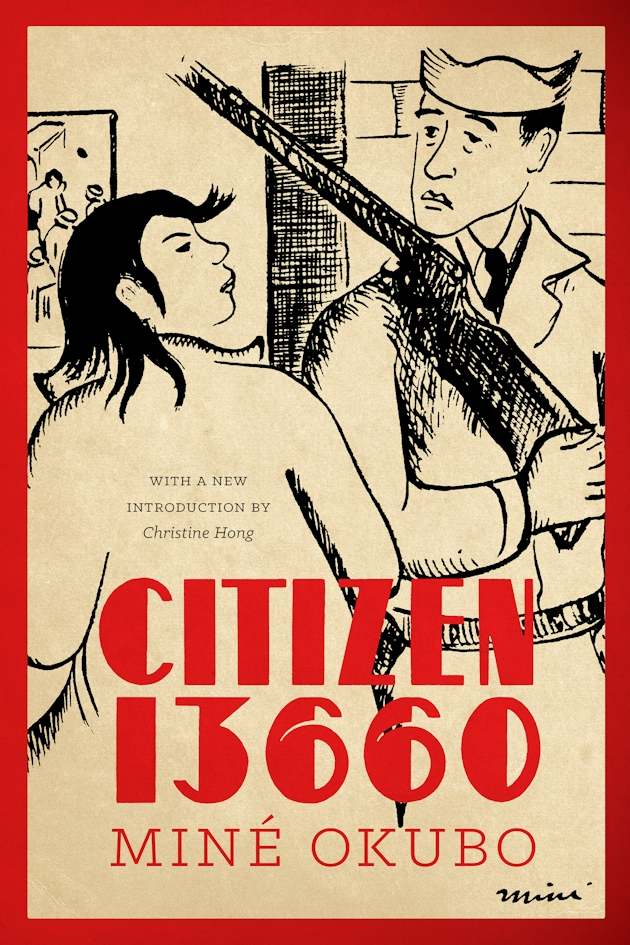
In early 1942, Miné Okubo was a working artist with a Master of Fine Arts from UC Berkeley, attempting to establish a career. Almost overnight, the U.S. government’s signing of Executive Order 9066 transformed her from an individual professional into a captive of the state. As she was forced from her home, the identity she had built for herself became secondary to the number she was assigned. “The number was on suitcases and everything you owned,” she later recalled; “You became a number”.1
This transition from a human being to a numbered incarceree is the central tension of her narrative. While the government sought to reduce 118,000 Japanese Americans to a faceless collective, Okubo turned to her sketchbook. Because photography was banned for detainees, her drawings became a rare, lasting visual testament to the actual conditions behind the barbed wire.
The Face of the Enemy
To understand the weight of Okubo’s drawings, one must first look at the visual landscape of 1940s America. The public was inundated with images that intentionally stripped Japanese people of their humanity. Political cartoonists, including the famous children’s author Dr. Seuss, frequently portrayed the Japanese as freakish, even in comparison to European enemies. His illustrations of European leaders, such as Adolf Hitler and Josef Stalin, were certainly exaggerated, yet they remained recognizable as individuals dictating countries with which Americans often felt generational ties.
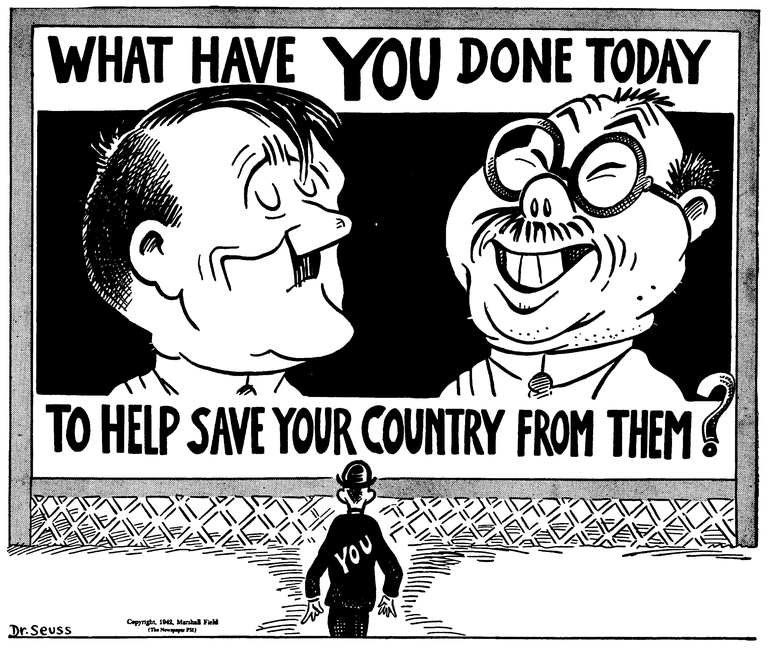
In contrast, Seuss’s depictions of Japanese Emperor Hirohito moved beyond stylistic exaggeration into the realm of racist caricature. Aside from the spectacles and a thin mustache attributable to the Japanese monarch, the buck-toothed smile, stuffed cheeks, extremely slanted eyes, and upturned nose in these illustrations created an amalgamation of features to create a sniveling villain of foreign proportions, rather than an exaggerated human likeness. It is often jarring to see how dignified a figure like Hitler appears in these cartoons compared to the wide-mouthed sneer and air of idiocy granted to his Japanese counterpart.
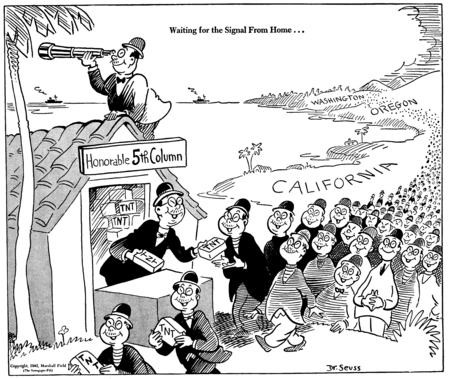
Beyond attacking the Japanese figurehead, Seuss frequently multiplied this stereotypical face to represent the Japanese people as a monolith. A particularly damaging cartoon depicted Japanese Americans on the West Coast lining up to receive boxes of TNT from a “Honorable 5th Column” stand. Each person in the crowd bears a face eerily similar to the caricatured Hirohito figure. Rather than just stoking rumors of conspiracy, the drawing presents a crowd of endless slanted eyes and conniving smiles that eventually fades into indistinguishable dots on the horizon.
Government documents of the time actively encouraged this blurring of identities, with official messages stating that “all Japanese look very much alike to a white person,”2 and that it was nearly impossible to distinguish a resident Japanese American from an enemy soldier. By establishing the Japanese as a homogenous, indistinguishable mass, the state justified lumping Japanese Americans with the Japanese Empire based solely on ethnicity and appearance, providing the visual and rhetorical logic for the mass incarceration of its own residents and citizens.
The Defiance of Detail
While it is difficult to say if Okubo set out with the explicit intent to undermine the widely disseminated Japanese American image, her artistic style performs a powerful subversion of these prevailing stereotypes. In Citizen 13660,3 she utilizes a faux-photographic focus that emphasizes the diversity of the incarcerated population. Unlike the homogenous crowds found in political cartoons of the era, Okubo’s panels are filled with highly detailed portraits of individuals. Her drawings showcase the physical variety of the Japanese American community without needing a single word of text to explain the significance.
In every frame of Citizen 13660, the individual faces demand our attention. Okubo’s sketches capture a remarkable range of physical diversity that was almost entirely absent from the American consciousness at the time. While her black-and-white graphite style might superficially resemble the political cartoons of the era, Okubo is able to use this form to restore individuality. Throughout the novel, you see a community of distinct people: some with hair in tight buns or side-swept bangs, others with visible cowlicks or balding heads. She even captures the unique wrinkles of a furrowed brow or a fearful frown, proving that in her eyes, despair had no universal expression among her fellow Japanese Americans.
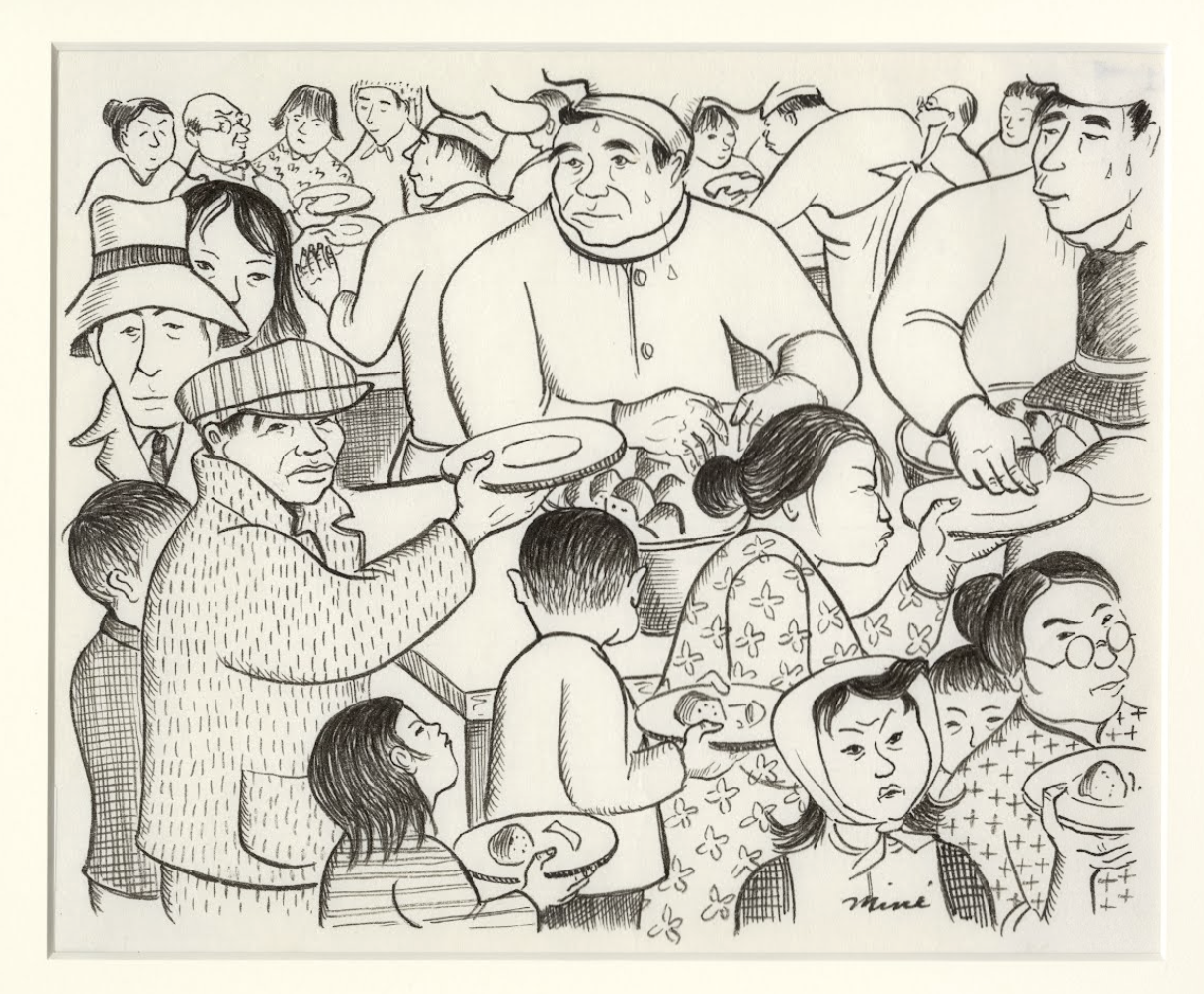
If you look closely at Okubo’s crowds, you’ll find it impossible to dismiss them as a faceless, homogenous mass. Even as figures recede into the background, they maintain their own distinct expressions and unique body shapes. She takes moments of collective upheaval—the frantic unloading of suitcases or the task of stuffing straw mattresses in dirt-floored barracks—and forces the viewer to slow down.
By rendering these scenes with such precision, she demands that we acknowledge the humanity of every individual she has so carefully drawn. These illustrations do more than just record daily life in camps; they actively dismantle the “yellow peril” caricatures of the 1940s, replacing racist stereotypes with the truthful, complex diversity of Japanese American bodies.
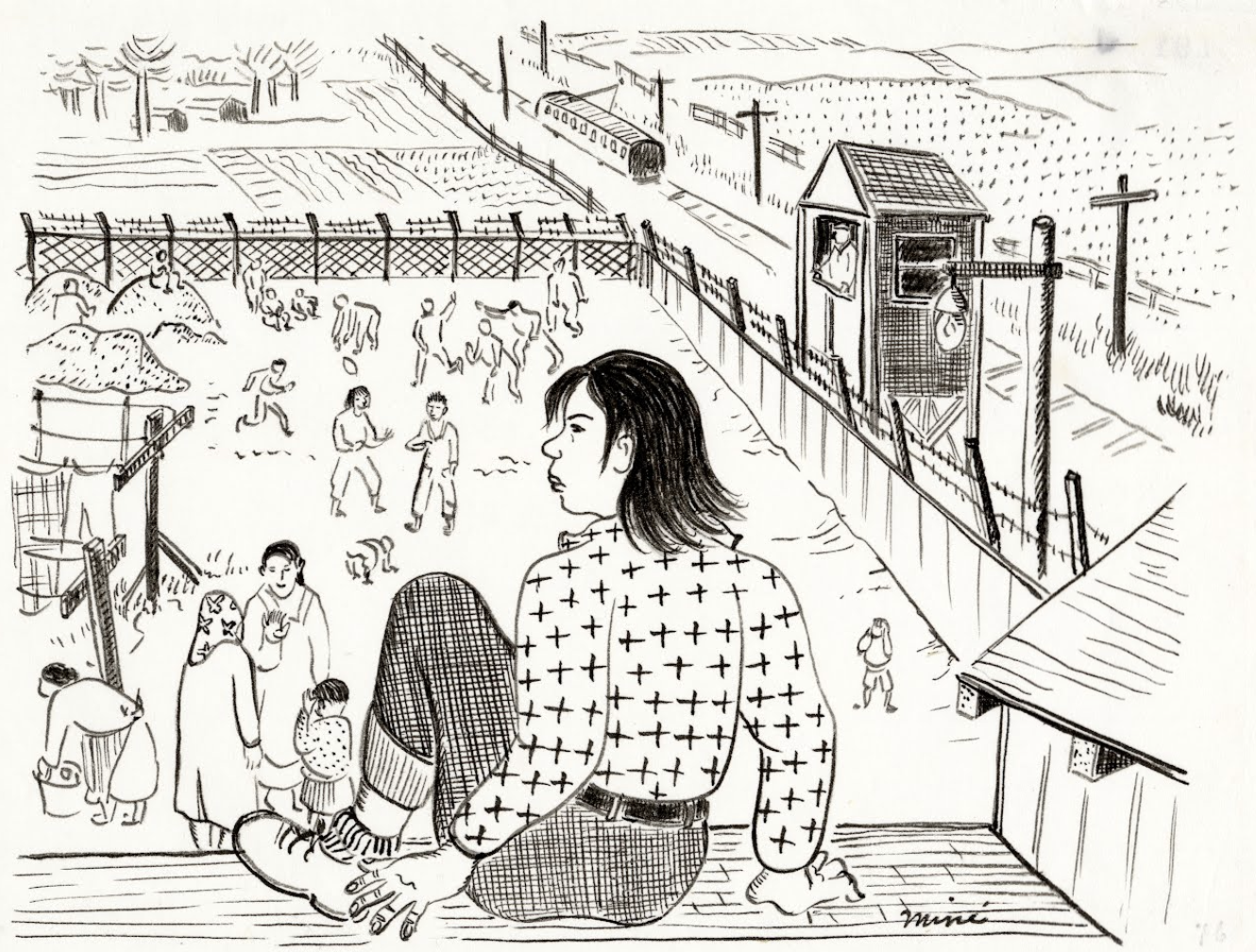
While Okubo is a constant presence throughout the sketches—often appearing as a lead figure in the frames—the book never feels like it is “truly” about her. She anchors the images, but her narrative voice remains notably impersonal, rarely centering her own individual suffering. This was a common trait among the fellow Nisei authors of her time, who often lived with a “psychic damage”4 that made personal disclosure or intimate self-reflection feel like an unnecessary risk. By leaving the emotional heavy lifting to her sketches rather than her words, Okubo found a way to speak without having to entirely expose herself alone.
By positioning herself this way, Okubo acts more like a guide than a heroic protagonist. She can be seen standing in the corner of a crowded dining hall, sitting at the back of a winding line for the shared toilets, or peeking around the corners of barracks to watch camp officials. While the reality of incarceration could easily cause an outsider audience to feel defensive or ashamed, Okubo inserts herself as both someone experiencing the trauma and someone observing it.
A Legacy at the Margins
This graphic posturing serves as a pictorial bridge for the reader. Rather than reinforcing the era’s propaganda of a “spy” for the Japanese Empire, Okubo becomes a witness for the American public. Her presence provides a safer space for an audience that might have felt indifferent toward the incarceration to sit with the dark reality of the concentration camps. She essentially invites the viewer to stand behind her, look past her, and finally see the humanity of the thousands of people sharing her fate.
Despite its revolutionary form, Citizen 13660 initially failed to reach a wide audience. Released in 1946—only a year after the United States dropped atomic bombs on Hiroshima and Nagasaki to ensure their victory over the Axis powers—the American public was largely unprepared to embrace Japanese American humanity. Their pain was often viewed as secondary to the survival of the larger populace, making it difficult for Okubo’s educational efforts to permeate the existing cultural opposition.
It took decades, and the distance of history, for stories of the incarceration to receive their proper recognition. While Okubo’s book was a revolutionary precursor to modern masterpieces like Art Spiegelman’s Maus or Marjane Satrapi’s Persepolis, it was long relegated to the margins. Today, however, I hope that we can see her work as an antecedent of an explosive literary tradition. By simply recording what she saw in detailed images and with her unique style, Miné Okubo ensured that the faces of those behind the gates were not erased by the caricatures of their time.
Notes:
- Eric Pace, “Miné Okubo, 88, Dies; Art Chronicled Internment Camps,” The New York Times, February 25, 2001. ↩︎
- Greg Robinson and Elena Tajima Creef, eds., Miné Okubo: For My People (University of Washington Press, 2008). ↩︎
- Miné Okubo, Citizen 13660 (University of Washington Press, 1983). ↩︎
- Michi Nishiura Weglyn, Years of Infamy: The Untold Story of America’s Concentration Camps (University of Washington Press, 1996). ↩︎
—
Guest post by Haeley Christensen
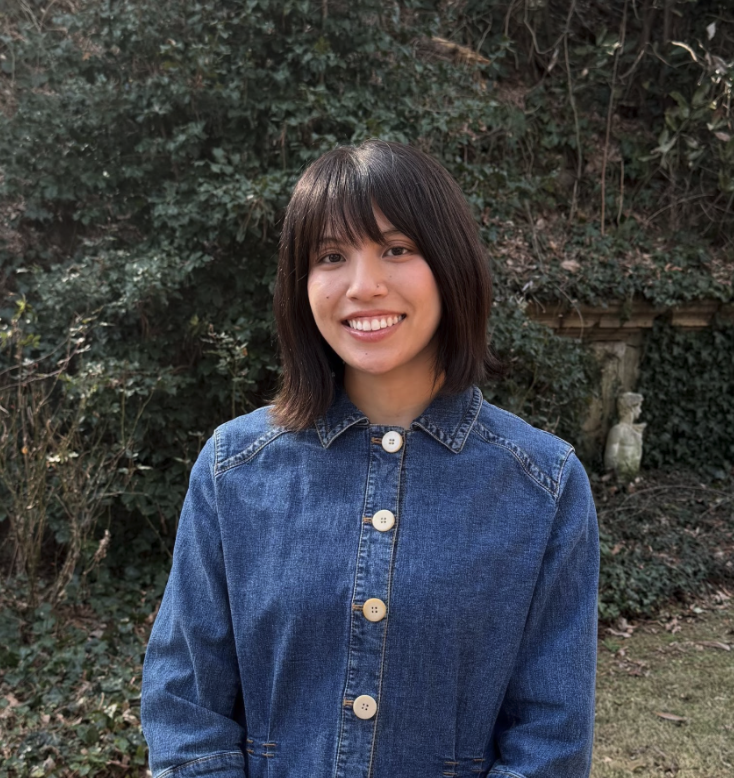
Haeley Christensen is a doctoral student in the English and Comparative Literature Department at UNC-Chapel Hill. Her research interests are rooted in Asian American and Critical Mixed Race studies. She is particularly drawn to how forms of storytelling—whether through text, image, or multimodal forms—can bridge gaps in readers’ understanding of intersectional experience, deepening engagement with the fluidity of identity in raced and gendered contexts. Outside of academics, Haeley is an occasional poet, the keystone of her weekly trivia group, and a stress-motivated scrapbooker.